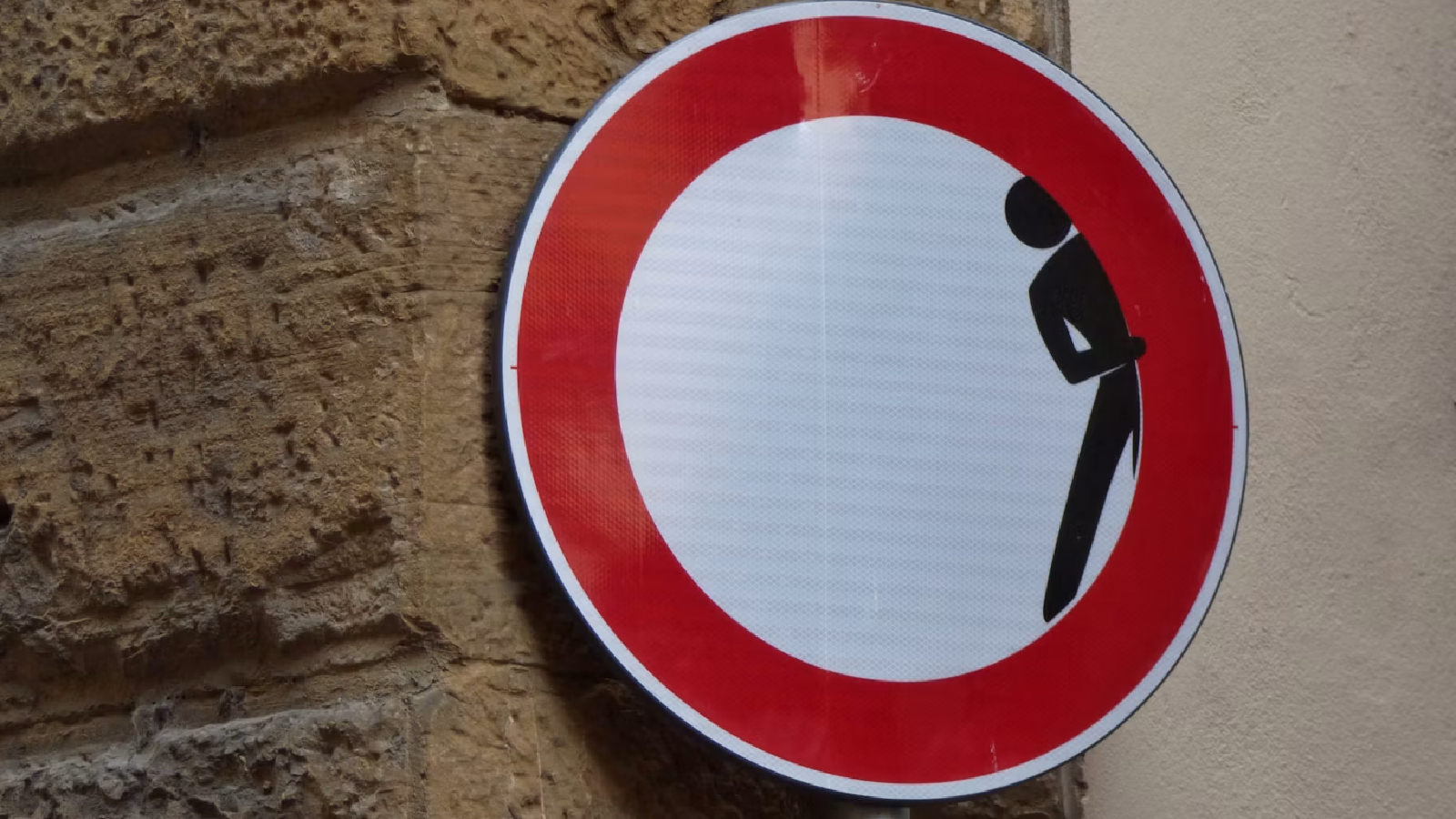
God is infinite mercy. He forgave David his adultery and murder. He forgave the greedy tax collector who was a traitor and He forgave the criminal on the cross. But there is, however, something that makes it impossible for God’s mercy to be poured out, and something that God detests within us – that is our unwavering, absolute seriousness; that I believe that I am someone important. Seeing this, it is as though God makes a gesture of spreading his hands out in helplessness. God finds our feeling of self-importance comical and absurd. “He who is enthroned in heaven laughs” (Ps 2:4). If we look at ourselves in the light of faith then we will see that all our pretence of absolute seriousness and esteem is truly absurd.
The feeling of self-importance is opposed, to a large degree, by the ‘virtue’ of humour. This virtue turns out to be very useful for the growth of our faith, which is seeing the world in the proper light and with the correct sense of proportion. Humour is seeing the world on the axis of absurdity and nonsense. We have a patron of humour – St Thomas More. We also have a wealth of literature on the subject by authors such as G.K. Chesterton, C.S. Lewis, B. Marshal, F. Sheed and others. They write about the value of comedy, about humour used as a spiritual remedy benefiting faith, and about the ‘theology’ of humour.
Jansenism as a great threat to Faith
The heresy of Jansenism became a great threat to the Faith in the 16th century. Cornelius Jansen taught that through Original Sin, human nature was completely corrupted and covetousness was dominant. He taught that God grants His graces only to the chosen ones, and all others are destined for eternal damnation. This pessimistic outlook on human nature was coupled with the belief that Christ died not for all mankind, but only for the chosen ones.
Jansenism set unattainable requirements for receiving Holy Communion, which the average Christian did not have. Complete freedom from sin, even venial sins, and absolutely pure love of God were required. The Eucharist became a payment for virtue and not the nourishment which strengthens faith and love. In the churches dominated by Jansenism, there was a mood of sadness, grimness and terror. Man began to fear God. Only rarely would he be brave enough to receive the Eucharist.
The Cistercian abbey in became the centre of Jansenism. The “Rosary to the Most Blessed Sacrament,” written by one of the nuns there, which emphasizes everything that separates God from man, is a testimony to the prevailing mood. God was not presented as a merciful and loving Father, but as an absolute, inaccessible, strict and ruthless Lord. According to Jansenist views, a Christian is a repentant sinner; therefore he cannot allow himself to experience joy. His life should be dominated by the sadness which comes from remembering his own sins. Blaise Pascal’s sister, the director of the Girls’ boarding house in , forbade laughter in the regulations for her pupils; even smiles were discouraged.
Jansenism was condemned several times by the Apostolic See, but its effects were still experienced by St Therese of Lisieux, who had to obtain special permission from her superior to receive Holy Communion more often. Another effect of Jansenism that appears often in a modern Christian’s life is an unhealthy fear of God, seeing Him only as the just Judge. But Christian faith most fully expresses itself in the joy of discovering the personal love of God, which we can depend on and to which we can entrust ourselves. Faith experienced in this way eradicates the attitude of dramatic fatalism towards one’s own evil, which our contrition can change into a ‘happy fault’. Christian joy flowing from faith is like a radiation of God’s love. It is faith that tells us to smile at God, to be joyful in His love. Then I should look at myself, whom I take much too seriously, from a certain distance and with a humorous perspective. The ‘virtue’ of humour allows us defeat the poison of sadness, with which Satan tries to permeate our soul. This virtue of humour causes us to cease worrying about ourselves and allows us to live a life of joy flowing from faith.
Humour as an ‘Exorcism’
The ‘virtue’ of humour, which is seeing the absurd in the world, is a spiritual remedy which may have the value of an exorcism. When we are resisting a wave of temptations, a wave of persistent thoughts which can tire us out, we should not fight with Satan, for he is stronger than us; rather we should try to ridicule him and scoff at him. We can use this ‘exorcism’, which is a religious sense of humour, by making fun of Satan. We can then repel his attack in the most effective way. A ridiculed Satan is most forcefully struck, since he is deadly serious, and very afraid of ridicule, and is therefore compelled to leave us.
The Christian sense of humour will also help us fight another enemy: our own ‘self.’ This is also an idol, which we take very seriously and which we consider untouchable and absolute. It must not be touched or ridiculed; it must not be offended or criticized. Using humour to fight this idol becomes a spiritual remedy and an act of faith when I look at myself and try to see that ‘self’ in the appropriate light: in reality, I am truly such an insignificant ‘nothing.’ Why then do I make myself the centre of the universe? Why do I believe that my concerns are so important? Why do I suffer from my defeats and troubles so much, and why am I so grim and serious? It would suffice to look at everything with a little bit of friendly ridicule, to see that what I am so worried about, what I fear and what I care about is really silly compared to the one important reality, which is God.
Christian humour is a remedy by which the idol of my ‘self’ is dethroned. When we see the humour in a situation in which our ‘self’ ascends to the throne, then, at least for a while, this situation is ridiculed and becomes harmless. Our vanity and pride become unmasked; that which pretended to be great or to be the threat arousing fear in us is ridiculed and unmasked. In this way, the spiritual remedy of humour also has the significant role of preserving our psychological balance.
Ashes and Dust
Humour is a ‘spiritual remedy’ by which I can tell myself, “Look how absurd I am. I worry about trifles, I become so caught up with my plans and projects that I am ruining my health; but, in reality everything is like ashes, like rubbish and finally may prove to be worthless.” I should try to look at my life in the light of faith; try to joke about myself. This may be difficult because the ‘virtue’ of humour sometimes requires heroism. Nevertheless it enables us to attain the proper proportion between the two realities: God and myself. In this way the virtue of humour cleanses our faith of egoism and strengthens it. It will show us with great clarity that only God is really important in my life. That is why we should not make ourselves the centre of the universe. I should perceive myself as a small grain of sand, as St Therese spoke of herself, a small ‘nothing’, which should not be too much cared for or troubled or worried about. “Pray,” said the Saint “that the grain of sand become an atom seen only by the eyes of Jesus!”
The Christian sense of humour will free us from ourselves. It will allow us to re-evaluate every value in the light of faith, and to acknowledge that everything that happens around us is really ridiculously insignificant – everything except God. It will allow us to unmask those things which only seem to be values. In comparison with the value which is God, everything in the end is ashes and dust – our work, our plans and our troubles, politics and that which happens all around us. It is in this spirit that we begin Lent with the liturgy of Ash Wednesday, when the priest places ashes on our heads and says that from dust we have arisen and into dust we shall return. Dust is something ridiculously insignificant. Not only are we dust, but so is all that we really care for and all we are attached to, as well as all that we fear. Thanks to the ‘virtue’ of humour, we will open ourselves more fully to God. There will be more room for Him because we are able to see everything else in its proper perspective – as ashes and dust. It means that we are able to set all this on the axis of absurdity.
With a perspective such as this we are able to see, for example, the conversion of St Francis of . When he threw everything at the feet of his father in order to follow the voice of God, suddenly he was free. It was as if the whole world turned upside down: “whoever has seen the whole world hanging by a thread of God’s Mercy, has really seen the truth. […] Whoever has had the vision of his home town turned upside down, has seen it the way it should be seen […] The man that has seen the hierarchy turned upside down will always have a slight smile towards its prerogatives” (G.K. Chesterton, Saint Francis of Assisi, ch. 5).
, the country and homeland of St. Francis of , was a feudal town surrounded by a moat, walls, and towers. Society in at that time was a ‘noble’ pyramid made up of several social groups, each subordinate to the other. There were the serious city elders, the serious noblemen, the burghers and the serfs. And suddenly this world was turned upside down and in the eyes of Francis it became something ridiculously insignificant. It would take only one push for ’s world of self important city elders, lords and noblemen to crack and collapse. All of this, seen by Francis on the axis of the absurd, became like ashes and dust. In the face of God, human strength became ridiculous and unimportant. Francis understood that there is only one important, serious reality worth living for, that is God and His will. It is God’s will that one must never laugh at; it should be loved. One should, as a child, trustfully hold onto that which alone is important.
At the basis of most of sins lies steadfast importance and absolute gravity. We sin because we consider ourselves so very important. Casting aside this importance through Christian humour, writes Walter Kasper, makes us capable of: “a serene and truly human existence.” Humour points out the drollness of our pretending to be important. Lack of humour and the accompanying irritability is one of the most important accusations levelled at modern Christians.
The Pharisees were people who were deadly serious. They were so very certain of their gravitas and importance. At the same time they were so attached to their vision of the world and God, that they reacted aggressively to accusations. Pharisaism is the opposite of simplicity. Simplicity includes freedom which flows from living in the truth and from seeing oneself in truth. Pharisaism at the same time is a contradiction of the attitude of an Evangelical child who, acknowledging his own weakness, is free of the feeling of self importance. It should be remembered that a sin against the Holy Spirit is one, where among other things, a person does not want to accept the truth about himself and does not acknowledge his own weakness.
Supernatural humour allows us to discover the true proportion between human and Godly realities. It allows us to gain greater distance, detachment and greater freedom. Being distanced from occurrences and from ourselves, achieved thanks to a sense of humour, enables us live the Gospel more fully. It allows for a change in the priorities of our own life, and our own concerns stop being the most important. It allows us to avoid being so self absorbed, to avoid excessive problems and inundation of work, in order to hear Christ’s message that there is need of only one thing (cf. Lk. 10:42). Owing to the ‘virtue’ of humour, failures and losses do not become life’s tragedies. Faith, supported by humour, can carry us even to the summits of detachment. Evangelical freedom is exemplified by St Paul’s principle of using the world in such a way as not to use it: “From now on, let those having wives act as not having them, those weeping as not weeping, those rejoicing as not rejoicing, those buying as not owning, those using the world as not using it fully” (1 Co 7:29-31). of the Cross encourages: “Strive so that all things are nothing to you and you nothing to them.”
St. Therese of the Child Jesus spoke of herself as a grain of sand, a small ‘nothing’. This is how her childlike attitude was expressed. It contains none of the grave seriousness which lies at the base of many of our sins. Most of our sins toward those who are close to us, come about because we feel insulted and hurt over nothing. In that which concerns us, we are often oversensitive and touchy. All of those sensitive, oversensitive and touchy people need a sense of humour, which liberates and brings freedom from their own selves. For people overly sensitive about themselves even the smallest detail grows to huge proportions. If we knew how to react with a sense of humour to various conflicts, arguments and misunderstandings and if we allowed ourselves to be laughed at a little, how much would our humility, faith and love grow from within us. In the light of faith, there is, however, only one important reality that must never be laughed at – God Himself.
Let us try to take ourselves and that which surrounds us a little less seriously and look at all of it more in the light of faith. We will then see how often it turns out that that which touches us deeply is fitting to be laughed or joked about. Let us try to laugh to ourselves and at ourselves. Try to imitate God, who must surely have a unique sense of humour. It is sufficient to consider that He has chosen us as his partner in the great work that He does. Is this not an expression of His unique sense of humour?
The Saint with Humour
The ‘virtue’ of humour in the saints reaches such a degree of heroism that it radiated even in the face of great suffering or death. St Thomas More, a saintly man, but still only a man, experienced psychophysical fears that arose in him just as we experience them. No one is free from fears; even our Saviour experienced them. most certainly feared the quartering and torture that he was told he would suffer. Later the sentence of torture was changed to beheading.
On the day of the execution Sir Thomas More changed into his best clothes and the Lieutenant, seeing this, demanded that he dress down. Finally, Sir Thomas had to do this. He was then brought out of the Tower and led to the place of execution. Before he walked onto the scaffold, the mood was very sombre and difficult to endure. A spiritual remedy of humour was needed. Thomas More then said to the officer in charge of the execution who was also deadly serious: “I pray you, Mr. Lieutenant, see me safely up; and as for my coming down, let me shift for myself” This quip is full of humour in the face of his own death.
King Henry VIII forbade him to speak – it is obvious how a person such as this can affect the people, a person whose sense of humour does not abandon him even in the face of death. What power this is! Even Satan fears a person with a true sense of spiritual humour, let alone Henry VIII. There was, therefore, no speech. The prisoner knelt, and after saying a prayer turned to the executioner and with a cheerful expression said to him, “Pluck up thy spirits, man, and be not afraid to do your job. My neck is very short. Take heed, therefore, not to miss your stroke, thus saving your honour.” Those were the last words of Saint Thomas More. He was able to laugh at himself; put himself, his concerns and even his own death on the axis of the absurd. For in the face of God, who is the one reality for whom it is worth living, even our own death is unimportant. St. Thomas More truly must have had the soul of a child, holding his Father’s hand very tightly in order to be able to joke in the face of his own death. This was done by one who had often prayed for a Christian sense of humour.
Excerpt from Chapter 2 of The Gift of Faith, by Tadeusz Dajczer
Photo by Belinda Fewings on Unsplash


