Synopsis
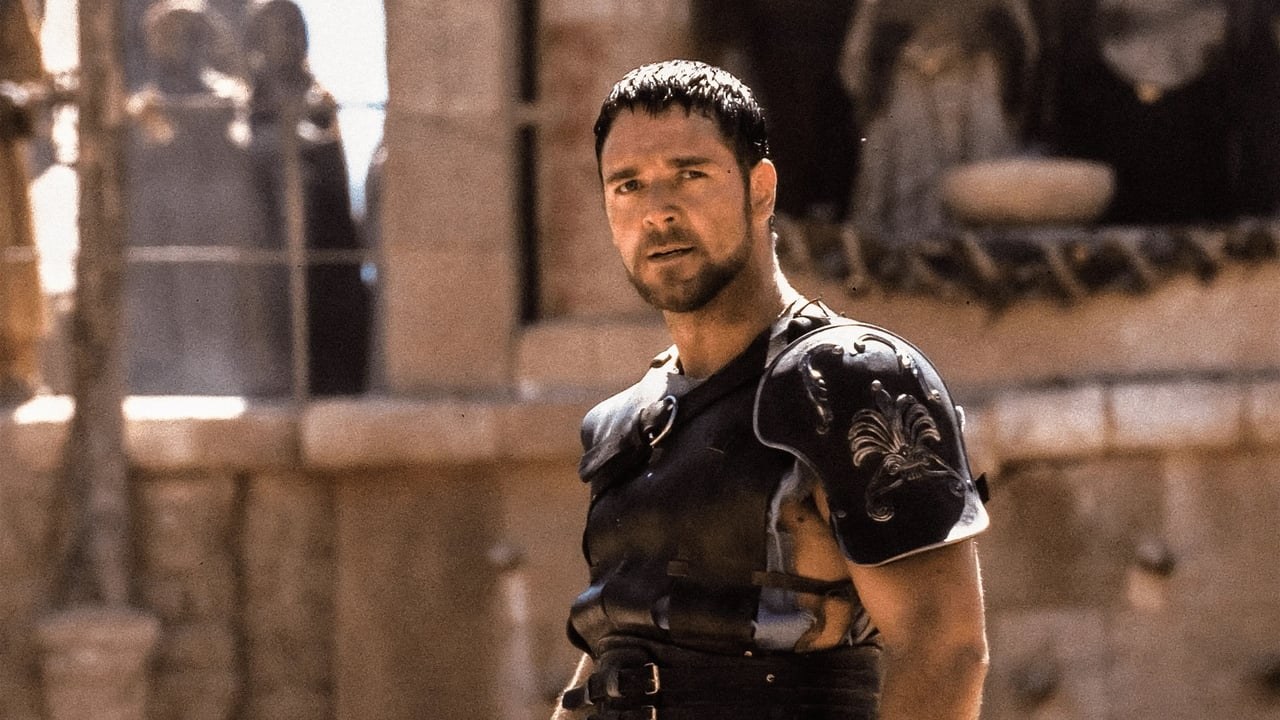
Maximus Decimus Meridius is a Roman general who has just led the empire’s legions to victory on the German frontier. The aging emperor, Marcus Aurelius, tells Maximus that he wishes him, and not his own son Commodus, to succeed him, so that power might return to the Senate and the Roman people rather than pass to another emperor. Commodus, overhearing this and desperate for a father’s approval he has never received, smothers Marcus Aurelius and seizes the throne. He orders Maximus’s execution, but Maximus escapes, only to arrive home too late to save his wife and son, who have been murdered on Commodus’s order.
Captured and sold into slavery, Maximus is trained as a gladiator by Proximo, a former gladiator himself. His skill and refusal to die anonymously in the arena make him famous under the name “the Spaniard.” Brought to Rome to fight in games Commodus stages to win the favor of the mob, Maximus reveals his identity to the new emperor in front of the crowd, and from that moment the two men are set on a collision course.
Maximus is drawn into a conspiracy with Senator Gracchus and Lucilla, Commodus’s sister, to restore the authority of the Senate. Commodus, sensing the threat, has Maximus wounded and poisoned before forcing him into a final public duel in the Colosseum. Weakened but resolved, Maximus kills Commodus, orders the restoration of Rome to the Senate and to Gracchus, and dies of his wounds, believing himself at last reunited with his wife and son.
Analysis
Duty Without Reward
Maximus’s most repeated description of himself is simply “a soldier who obeys.” He does not seek the throne Marcus Aurelius offers him, and he does not fight in the arena for glory or wealth. His virtue is most visible in what he refuses: he refuses to grasp at power even when it is placed within his reach, and he refuses to let the crowd’s applause become the measure of his worth. Duty, for Maximus, is something owed rather than something used for advancement, and this ordering of his desires is what allows him to remain, in a sense, free even as a slave.
This is worth pausing on, because it inverts an assumption many stories about ambition share: that a man’s worth is proven by how high he climbs. Maximus’s worth is instead proven by his constancy — by doing the same thing, well and without complaint, whether he is a general commanding legions or a slave fighting for his life. Fidelity to a task, not the rank attached to it, is what the film asks us to admire in him.
A Wound Mistaken for Ambition
Commodus is not simply a man greedy for power; the film is careful to show that his tyranny grows out of an unhealed wound. He tells his father plainly that ambition, resourcefulness, and courage were never the virtues Marcus Aurelius prized in him — and that what Commodus wanted most, and never received, was simply to be loved. His crimes flow from this disordered longing: unable to earn his father’s love through virtue, he takes by force the position he believes will finally command respect.
This does not excuse Commodus, but it complicates him in an instructive way. A desire that is good in itself — the desire to be loved by one’s father — becomes destructive once a person decides to satisfy it by illegitimate means. Commodus never stops wanting to be seen as worthy; he simply stops caring whether he actually becomes worthy, and settles for the appearance of it, enforced by power.
Suffering Without Despair
Maximus loses everything a man can lose — rank, freedom, wife, and son — within the span of a single act of treachery. The film does not minimize this loss; his grief is one of the most restrained yet devastating portrayals in the story. And yet Maximus does not become cruel, nor does he abandon the moral instincts that defined him as a general. He remains capable of loyalty (to Proximo, to Juba, to Cicero), capable of mercy (sparing defeated opponents when he is not required to), and capable of hope, however faint, that he will see his family again.
Suffering, in other words, does not automatically corrupt or ennoble a person — it reveals what was already there. Commodus’s cruelty was already present before Marcus Aurelius’s death; Maximus’s integrity was already present before his own losses. What the film suggests is that character is tested by suffering rather than created by it.
Power Surrendered Rather Than Seized
The final act of the film is not Maximus claiming the throne he was originally offered, but Maximus giving power away — ordering, with his dying breath, that Rome be returned to the Senate and to Gracchus. Having every justification, by that point, to rule, he instead completes the very reform his mentor had asked of him at the beginning. His revenge against Commodus and his fulfillment of Marcus Aurelius’s wish turn out to be the same act.
This closes the film’s argument: the man fit to hold power is precisely the man who does not need to hold it for himself. Maximus’s entire arc has been a demonstration that he was worthy of the position he never wanted, which is what made him worthy of it in the first place.
Questions for Discussion
1. Maximus repeatedly calls himself “a soldier who obeys.” What does obedience cost him over the course of the film, and what does it protect in him?
2. Marcus Aurelius wants to return power to the Senate rather than pass it to an heir. Why might he see this as more important than securing his own family’s rule?
3. Commodus says his father wanted virtues in him — ambition, resourcefulness, courage — but what he wanted was simply his father’s love. Does this explanation make his actions more understandable? Does it make them less wrong?
4. Compare Maximus and Commodus as sons: one loses his father figure and remains faithful to his teaching; the other loses (or destroys) his father and abandons everything his father stood for. What accounts for the difference?
5. Maximus loses his family, his rank, and his freedom, yet does not become cruel or vengeful toward those who had nothing to do with his loss. What does this suggest about the relationship between suffering and character?
6. Proximo tells Maximus to “win the crowd,” while Maximus continues to fight for reasons that have nothing to do with the crowd’s approval. What is the difference between a man who performs for applause and a man who happens to be applauded?
7. Maximus shows mercy to defeated opponents in the arena even when the crowd wants blood. What does this reveal about how he understands strength?
8. At the end of the film, Maximus has the opportunity to rule Rome but instead restores the Senate. What does this decision cost him, and what does it accomplish that seizing power would not have?
9. Is Maximus’s quest ultimately about revenge against Commodus, or about something larger that revenge happens to serve? Defend your answer with specific moments from the film.
10. What do you think the film means by its recurring idea that “what we do in life echoes in eternity”? How does this idea shape the choices Maximus makes when no one is watching?


