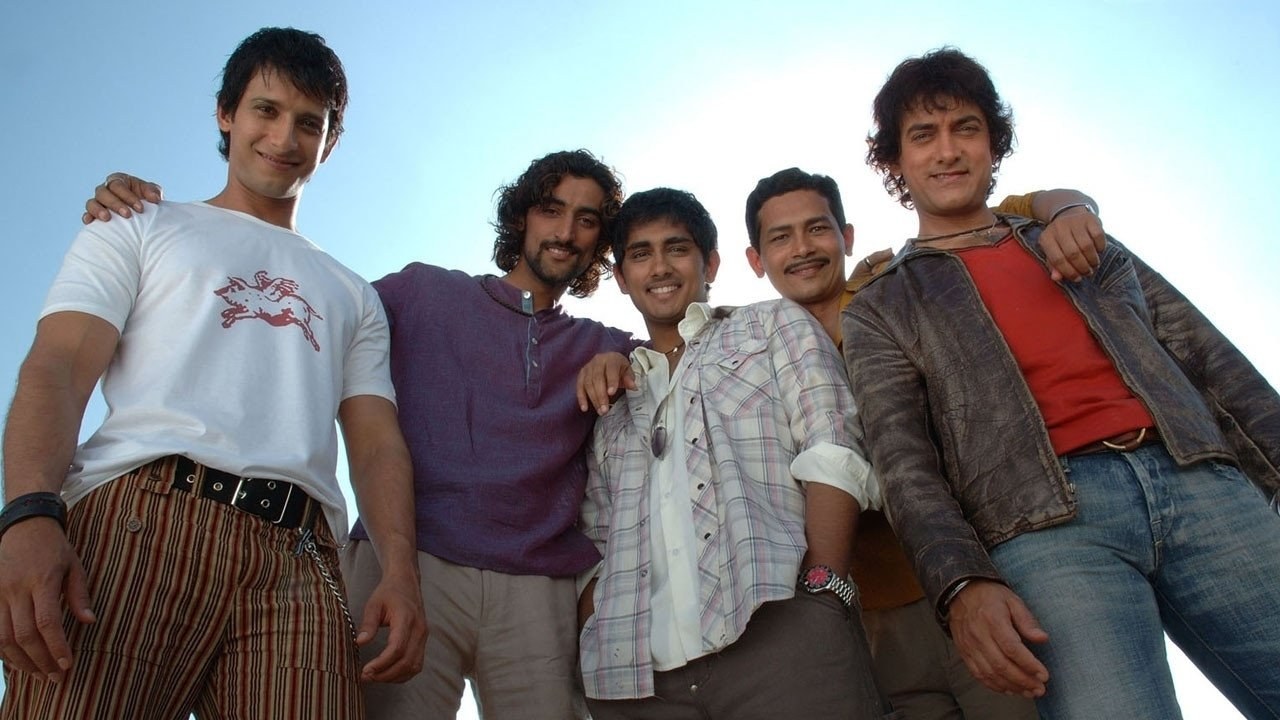
Synopsis
Sue, a young British filmmaker, travels to India to make a documentary based on her grandfather’s diary about a group of revolutionary Indian freedom fighters who resisted British colonial rule in the 1920s, recruiting a group of politically disengaged, cynical Delhi University students – more interested in parties and casual rebellion against authority than any genuine political conviction – to play the historical revolutionaries in her film.
As the students research and portray these historical figures, reenacting their sacrifices and convictions for Sue’s camera, they are simultaneously confronted with contemporary corruption when their friend, an Air Force pilot, dies in a crash caused by defective equipment that corrupt officials had covered up for personal profit, and the government responds to the resulting public outcry not with accountability but with further denial and the arrest of the pilot’s grieving mother for peaceful protest.
Radicalized by this direct experience of institutional corruption and injustice, and increasingly identifying with the historical revolutionaries they had merely been portraying for entertainment, the students undertake their own act of political violence – assassinating the corrupt defense minister responsible for the cover-up – understanding, as their historical counterparts did, that this act will cost them their own lives in the ensuing confrontation with authorities, a sacrifice they accept as necessary to force public reckoning with the corruption otherwise being successfully concealed.
Analysis
History Reenacted Becomes History Repeated
The students’ initial engagement with their revolutionary roles is purely performative, undertaken for a film project rather than any genuine political conviction, yet the process of researching and embodying these historical figures’ sacrifice and courage gradually reshapes their own understanding of what genuine conviction might require of them personally.
This transformation from performance to genuine conviction suggests that sustained, serious engagement with historical examples of courage and sacrifice, even when initially undertaken for other purposes, retains the power to genuinely form character and conviction in those who take the exercise seriously enough.
Corruption That Costs Innocent Lives
The defective equipment cover-up that kills the students’ friend represents corruption not as an abstract, victimless failing but as a direct, deadly betrayal of public trust, with real human cost borne by those who had no part in the corrupt arrangement itself and no meaningful institutional recourse once the truth becomes known.
This portrayal of corruption’s concrete, lethal human cost, rather than treating it as a merely technical or abstract failing, grounds the students’ subsequent radicalization in a specific, undeniable injustice rather than an abstract political grievance, giving their eventual response real moral weight even as the film raises serious questions about the legitimacy of the violent means they ultimately choose.
Violence Chosen Knowing Its Cost
The students’ assassination of the corrupt minister is undertaken with full awareness that it will cost them their own lives in the aftermath, mirroring the historical revolutionaries’ own willingness to accept execution as the price of their resistance, framing their act less as an attempt at personal escape or survival than as a deliberate, sacrificial act meant to force public attention onto corruption otherwise being successfully concealed.
This willingness to accept certain personal cost for the sake of exposing injustice raises the film’s most serious and unresolved moral question: whether such violent, sacrificial resistance against entrenched corruption can be justified when legitimate institutional channels have demonstrably failed to provide accountability, a question the film poses with genuine seriousness rather than offering an easy resolution.
A Generation Awakened From Political Apathy
The students’ initial cynicism and disengagement from political life, common among their peers, reflects a broader generational disillusionment with a political system perceived as hopelessly corrupt and unresponsive, a disillusionment the film treats sympathetically even while ultimately arguing that such disengagement is inadequate once genuine, undeniable injustice becomes directly, personally visible.
This arc from apathy to costly engagement offers a pointed challenge to political disengagement as an acceptable long-term response to systemic injustice, suggesting that such apathy, however understandable given genuine institutional failure, cannot remain a permanent or adequate response once injustice touches those we love directly.
Questions for Discussion
1. The students’ initial engagement with their revolutionary roles is purely performative, undertaken for a film rather than genuine conviction. What allows this performance to gradually reshape their actual convictions?
2. The equipment cover-up that kills the students’ friend represents corruption with a direct, deadly human cost. How does this concrete injustice differ from a more abstract political grievance, and how does this specificity shape the students’ response?
3. The students choose an act of violence knowing it will cost them their own lives. Is this sacrificial violence morally justified, given the failure of legitimate institutional channels to provide accountability? Explain your reasoning.
4. The students begin the film politically disengaged and cynical about their ability to effect change. What does their eventual transformation suggest about the limits of apathy as a response to systemic injustice?
5. How does the film’s parallel structure, connecting historical revolutionaries to contemporary students, shape your understanding of whether their violent response is justified or merely repeats a cycle of costly, uncertain resistance?
6. What responsibility do government officials bear when corruption directly causes preventable deaths, and what recourse should exist for grieving families when official channels fail to provide accountability?
7. Is the students’ assassination of the corrupt minister an act of genuine justice, an act of vengeance, or something the film deliberately leaves ambiguous? Defend your interpretation.
8. What do you think the film ultimately suggests about the relationship between historical memory, present injustice, and the willingness to sacrifice oneself for the sake of exposing wrongdoing?


