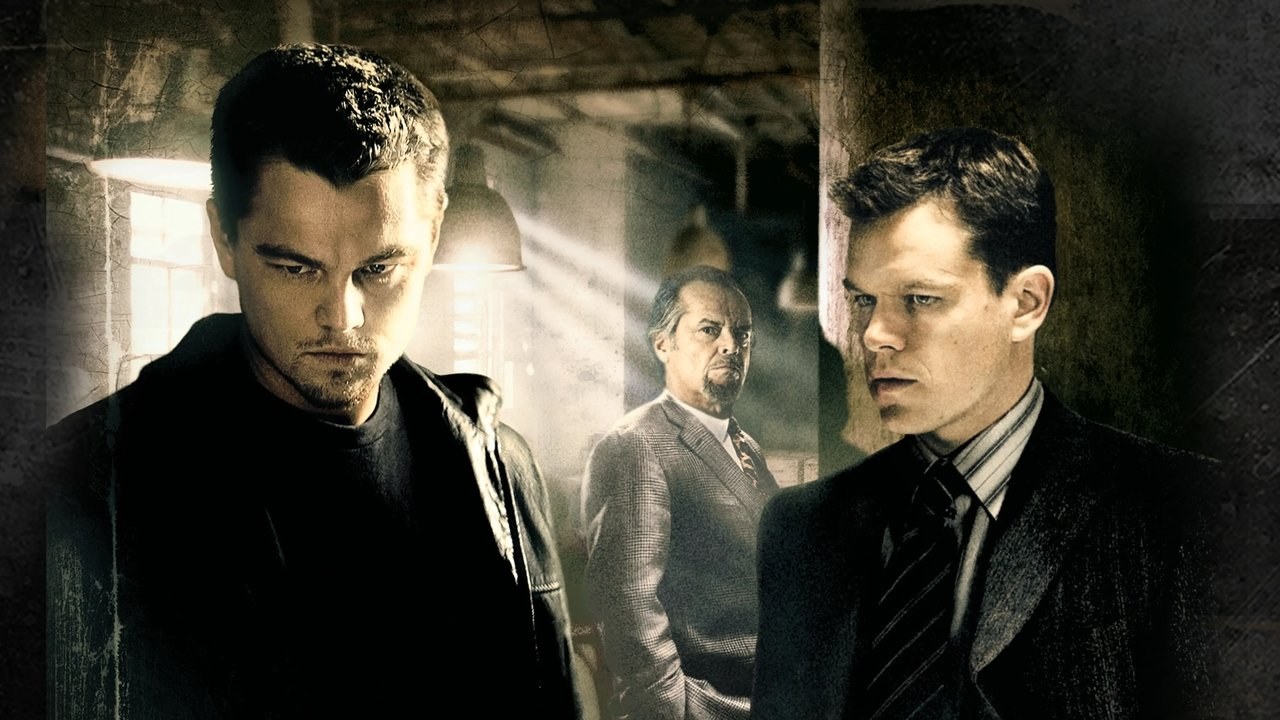
Synopsis
In Boston, Colin Sullivan, raised from youth as a protégé of powerful Irish mob boss Frank Costello, infiltrates the state police as an undercover mole for Costello’s organization, rising quickly through the ranks while feeding Costello inside information that allows him to evade law enforcement’s repeated attempts to bring him down. Simultaneously, Billy Costigan, a young officer from a troubled family background, is recruited by the police to go undercover within Costello’s own organization, sacrificing his official identity and record entirely in order to infiltrate the gang from within and gather evidence against it.
As both moles rise within their respective infiltrated organizations, each becomes aware that the other side has a mole embedded within their own ranks, without knowing the other’s actual identity, setting off an escalating, paranoid game in which both Sullivan and Costigan must work simultaneously to protect their own cover, uncover the other’s identity, and survive within environments where discovery means near-certain death.
As the pressure mounts on both men, Costigan’s psychological toll from years of sustained deception and violence grows increasingly unbearable, while Sullivan’s outwardly successful, respected position within the police becomes increasingly precarious as his own crimes threaten exposure. The film’s brutal, cascading final confrontations – in which nearly every major character, including Costello, Costigan, and eventually Sullivan himself, meets a violent end – offer a bleak final statement about the corrosive, ultimately unsustainable cost of lives built entirely on sustained deception, regardless of which side of the law that deception nominally serves.
Analysis
Identity Eroded by Sustained Deception
Both Sullivan and Costigan must maintain elaborate, sustained deceptions about their true loyalties and identities for years, a psychological burden the film portrays as genuinely corrosive to each man’s sense of self, particularly for Costigan, whose growing instability and paranoia reflect the real cost of living so thoroughly divided between his true purpose and his necessary public performance.
This portrayal of sustained deception’s corrosive effect on identity, regardless of the ultimately legitimate purpose it serves for Costigan, suggests that even morally justified deception carried out over a sustained period exacts a genuine psychological toll that cannot be fully separated from the deception’s nominal purpose or justification.
Loyalty Corrupted From Childhood
Sullivan’s loyalty to Costello, cultivated from his youth by a mob boss who essentially raised and shaped him as a surrogate father figure, represents a form of formation corrupted from its very foundation, raising serious questions about how much genuine moral responsibility a person bears for loyalties instilled so early and so thoroughly by those who held power over his formation.
This portrayal complicates any simple judgment of Sullivan as merely and straightforwardly a villain, without excusing his adult choices to continue and deepen this corrupted loyalty once he possesses full capacity to recognize and reject it, insisting on a more complicated moral accounting that acknowledges both his corrupted formation and his subsequent, freely chosen complicity.
Institutions Compromised From Within
The Massachusetts State Police’s institutional integrity is directly compromised by Sullivan’s embedded presence, illustrating how thoroughly even well-resourced, legitimate institutions can be undermined from within by a single sufficiently placed, sufficiently trusted mole, regardless of the institution’s overall competence or good intentions.
This portrayal offers a sobering account of institutional vulnerability to internal corruption, suggesting that trust and legitimate authority, however carefully cultivated, remain permanently vulnerable to exploitation by individuals whose true loyalties lie elsewhere, undetected precisely because of the trust their position affords them.
A Bleak Reckoning for All Who Live by Deception
The film’s cascading final violence, claiming nearly every major character regardless of which side of the law they nominally served, refuses to offer any character – however sympathetic their underlying motives – a clean escape from the consequences of a life built on sustained deception and violence.
This refusal to spare even the more sympathetic characters, including the ostensibly heroic Costigan, from the story’s ultimate violent reckoning suggests a bleak, unflinching assessment that lives built entirely around infiltration and deception, however justified their initial purpose, tend toward destruction regardless of the deceiver’s underlying moral intentions.
Questions for Discussion
1. Both Sullivan and Costigan must maintain sustained deceptions about their true identities and loyalties for years. What does the film suggest this sustained deception costs each man, psychologically and morally, regardless of which side they actually serve?
2. Sullivan’s loyalty to Costello is cultivated from childhood by a corrupt father figure. How much responsibility does Sullivan bear as an adult for a loyalty instilled so early and thoroughly in his formation?
3. Sullivan’s presence as a mole compromises the State Police from within. What does this vulnerability suggest about the limits of institutional integrity, however well-resourced or well-intentioned an institution might otherwise be?
4. The film’s ending claims nearly every major character, regardless of which side of the law they served. What does this bleak, comprehensive reckoning suggest about the film’s overall judgment on lives built around sustained deception?
5. Is Costigan’s undercover work, despite its ultimately legitimate purpose, morally equivalent in its psychological cost to Sullivan’s corrupt infiltration of the police? Explain your reasoning.
6. What responsibility do institutions bear for protecting and supporting undercover operatives like Costigan, given the severe psychological toll his assignment exacts on him?
7. How does the film’s parallel structure, following two moles on opposite sides of the same conflict, shape your understanding of the similarities and differences between their situations?
8. What do you think the film ultimately suggests about whether the ends of infiltration and deception, however legitimate, can ever fully justify the human cost such sustained deception requires of those who carry it out?


