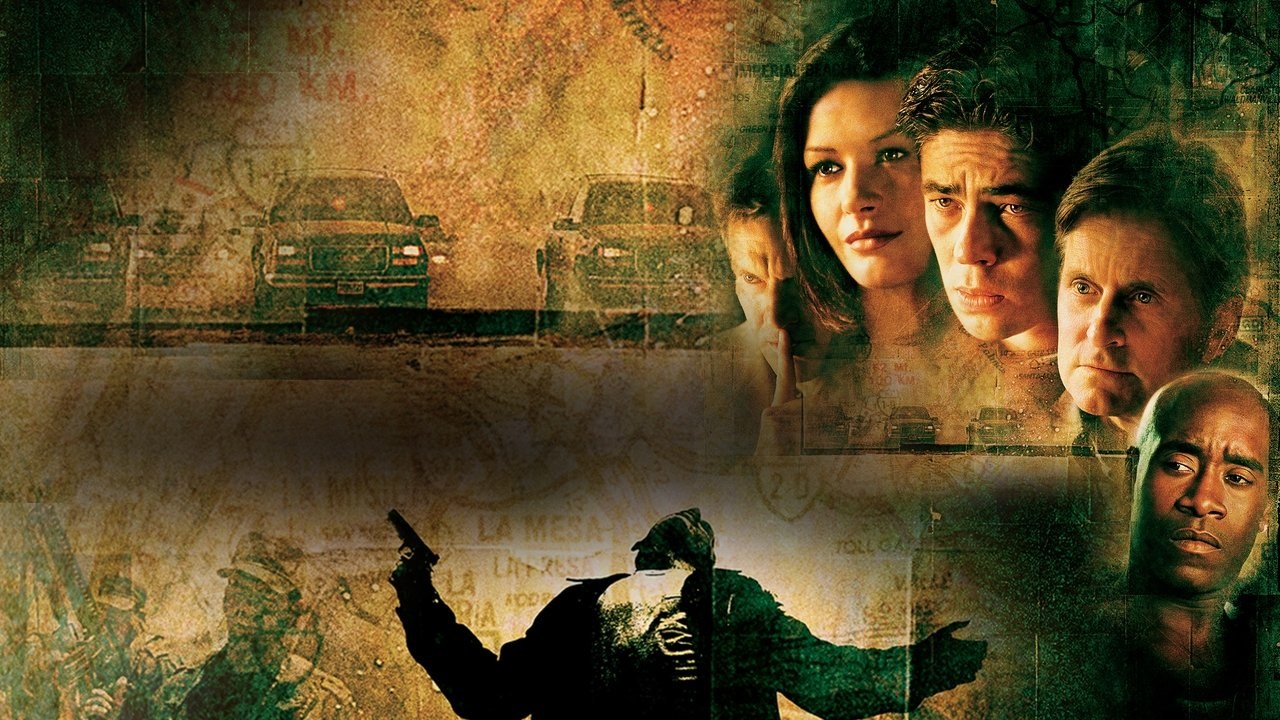
Synopsis
Robert Wakefield, a newly appointed conservative judge tasked with leading America’s drug policy efforts as national drug czar, begins his role with genuine conviction about winning the war on drugs, unaware that his own teenage daughter, Caroline, has developed a serious cocaine addiction that will spiral, over the course of the film, into far more dangerous territory, forcing Wakefield to confront the vast gap between the abstract policy debates he engages in professionally and the devastating reality of addiction within his own family.
Simultaneously, in Mexico, Javier Rodriguez, an idealistic but increasingly compromised police officer, navigates a treacherous landscape of cartel violence and pervasive institutional corruption, attempting to do genuine good within a system where nearly every official above him is compromised, while in San Diego, DEA agents work to build a case against a wealthy drug distributor whose seemingly ordinary, pregnant wife, Helena, is forced to take over and expand the family’s drug operation herself once her husband’s arrest threatens their family’s financial security and safety.
As these three storylines converge and intersect, each illustrating a different facet of the drug trade’s devastating human cost – from addiction’s intimate, personal wreckage to institutional corruption’s corrosive effect on legitimate governance to ordinary people’s desperate choices under extreme pressure – the film builds toward a collective, sobering conclusion that the drug war, as currently waged across multiple fronts and countries, has produced enormous human suffering while making little genuine progress against the trade’s underlying scale and profitability.
Analysis
Policy Confronted by Personal Reality
Wakefield’s professional confidence in the drug war’s basic strategy and premises collapses under the weight of his own daughter’s addiction, forcing him to reckon directly with how inadequately his abstract policy framework accounts for addiction’s actual, devastating human reality – a gap between policy theory and lived experience that no amount of professional expertise had prepared him to bridge.
This portrayal of policy confronted by intimate personal reality offers a pointed critique of how easily those who craft and implement policy can remain insulated from its actual human consequences, suggesting that genuine wisdom about complex social problems often requires exactly this kind of direct, personal confrontation with a problem’s lived reality rather than its abstract, statistical representation alone.
Integrity Tested Within a Thoroughly Compromised System
Javier’s attempt to maintain genuine integrity and effectiveness as a police officer within a Mexican law enforcement and political system riddled with cartel corruption at nearly every level illustrates the severe difficulty of pursuing individual virtue within institutions where such virtue is not merely unsupported but actively dangerous to maintain.
This portrayal of integrity under severe institutional pressure raises difficult questions about how much individual virtue can actually accomplish within thoroughly compromised systems, without either excusing complicity in corruption or pretending that individual moral courage alone can fully overcome structural, institutional failure.
Desperation Producing Unlikely Complicity
Helena’s transformation from an apparently uninvolved, comfortable suburban wife into an active leader of her husband’s drug operation, driven by genuine desperation to protect her family’s financial security and safety once her husband’s arrest threatens both, illustrates how ordinary people, under sufficient pressure and perceived necessity, can become complicit in systems of harm they had previously remained entirely detached from.
This portrayal complicates any simple division between innocent bystanders and willing criminal participants, suggesting that circumstances of sufficient desperation and perceived necessity can draw even previously uninvolved people into active complicity, raising uncomfortable questions about how much moral responsibility such circumstantially-driven choices actually carry.
A War Producing Suffering Without Corresponding Progress
The film’s interweaving of these three storylines, each illustrating different facets of the drug trade’s human cost across different countries, classes, and levels of institutional involvement, builds toward a collective argument that the drug war’s enormous human cost – addiction, violence, institutional corruption, family destruction – has not been matched by any corresponding genuine progress against the trade’s underlying scale.
This sobering collective portrait invites serious reconsideration of policy approaches that produce such extensive human suffering without demonstrable corresponding benefit, suggesting that genuine wisdom about complex social problems requires honest assessment of whether current strategies are actually achieving their stated goals, regardless of how well-intentioned or politically popular those strategies might otherwise be.
Questions for Discussion
1. Wakefield’s professional confidence in the drug war collapses upon confronting his own daughter’s addiction. What does this gap between abstract policy and lived experience suggest about the limits of expertise divorced from direct personal encounter with a problem?
2. Javier attempts to maintain integrity within a law enforcement system riddled with corruption. How much can individual virtue actually accomplish within a thoroughly compromised institutional system, according to the film’s portrayal?
3. Helena becomes actively complicit in her family’s drug operation under genuine desperation and perceived necessity. Does this context mitigate her moral responsibility, or does the film suggest she remains fully culpable for her choices? Explain your reasoning.
4. The film’s three storylines collectively suggest the drug war produces enormous suffering without corresponding progress. What does this argument suggest about how policy approaches should be evaluated and potentially reconsidered?
5. What responsibility do policymakers bear for understanding the lived, human reality of the problems they craft policy to address, given Wakefield’s initial insulation from addiction’s actual impact?
6. Is Javier’s limited, compromised effectiveness within a corrupt system still morally valuable, or does the film suggest that operating within such a system inevitably compromises even well-intentioned individual efforts?
7. How does the film’s structure, following three seemingly separate storylines that gradually reveal their interconnection, shape your understanding of the drug trade as a systemic rather than isolated phenomenon?
8. What do you think the film ultimately suggests should be done differently, given its sobering assessment of the drug war’s human cost without corresponding progress against the trade itself?


