Flannery O’Connor, a writer of fiction from the American South who died in 1964, wrote stories about people whose lives are touched by grace. She rebelled against the modern notion that grace is something soft and soothing that comforts us. She maintained that “grace cuts with the sword Christ said he came to bring. It is never received warmly. There is always a recoil.” She states “the reader wants his grace warm and binding, not dark and disruptive.” But grace is not like that. She held that redemptive grace always comes in the form of the cross and must necessarily do violence to the person, wrenching him out of his self satisfaction and self absorption.
The screenplay for 3:10 to Yuma could easily have been written by Flannery O’Connor, for it is a wonderful example of the dark and disruptive grace that she speaks about. It is also a magnificent Western that explores the concepts of grace and heroism through the intertwining stories of its two main protagonists, Dan Evans (Christian Bale) and Ben Wade (Russell Crowe).
On the surface, the story is simply told. Dan Evans, having lost a leg in the Civil War, has moved west to Arizona with his family to try to eke out a living on a ranch because the younger of his two sons has tuberculosis and needs to live in a dry climate.
He is having a very hard time of it because of a long drought and because a neighbour, who holds the mortgage on his land, is damming the stream that should flow through his property and has burnt Dan’s barn to try to force him off the land so he can foreclose on it and sell it to the railroad.
Dan has lost the confidence of his wife and older, teenage son Will, who doubt he can make the ranch work. His son also sees him as a failure because he does not stand up to the armed men who have burnt down his barn. Dan judges himself to be a failure as well. In addition, far from being a war hero, he lost his leg because one of his fellow soldiers accidentally shot him.
The second protagonist is Ben Wade, a notorious criminal who, with his gang, holds up stage coaches, robs banks and calmly murders anyone who gets in his way.
When Dan Evans rides into town to confront the neighbour who has burnt down his barn he unwittingly becomes involved in the capture of Ben Wade. This provides Dan with an opportunity to obtain the money he needs to save his ranch. Since he is a sharpshooter he is hired for a large fee to join the posse that is to escort Wade as a prisoner to the town of Contention where the 3:10 p.m. train has a jail cell and will transport Wade to the prison in Yuma where he will be hanged for murder.
Although the posse originally consists of four others besides Dan and is also joined by Dan’s older son, in the end, after many adventures, Dan finds himself alone with Ben Wade in a room in the Contention hotel, surrounded by Wade’s murderous gang and many others who have been promised a large sum of money to kill Dan and rescue Ben Wade. The denouement will see whether Dan can indeed deliver Ben to the train and thereby claim his fee and so save his ranch from foreclosure.
The movie’s themes of heroism and redemptive grace are played out through this plot and through the interaction between Ben and Dan and their relations with the secondary characters.
Ben is not merely a vicious killer, but also a profound and complex character capable of self examination and reflection. He sketches, he likes to read and philosophize, and is far more intelligent than the brutal thugs who make up his gang. He knows the Bible well, understands it and is always quoting it. But he is cynical. He knows that violating biblical morality is wrong, but has never met anyone who actually follows that morality, and so thinks that it is impossible to do so. He has never met anyone noble or come into contact with anyone who is willing to sacrifice himself for someone else or for a noble ideal. His first experience of the Bible was when his mother gave it to him to read to distract him so she could abandon him.
At one point Dan’s son tells Wade that he is not all bad. Wade protests that he is. Deep down, however, Dan’s son is right. At one point Wade says that he avoids doing any good deed, because it can be habit forming. He certainly knows right from wrong but avoids doing the good because of where it might lead him. The slightest good deed on his part would be seen as a sign of weakness by his gang and would lead to their desertion of him and probably to their killing him.
MacElroy is a professional bounty hunter who also forms part of the posse. Like Ben he also knows the Bible. However, whereas Wade knows himself not to be a good Christian, MacElroy considers himself to be one. But he does not hesitate to slaughter many women and children in an Indian village. So although he knows the Bible, unlike Wade he doesn’t understand it. He thinks he is living by it, but he really is not. He is the kind of hypocrite that Wade has had to deal with all his life and is the source of his cynicism.
Dan’s son, Will, is a voracious reader of dime novels that portray gunslingers like Ben Wade as heroes. Will idealizes that way of life and his concept of a hero is an outlaw with flashy guns.
At one point Will shows his disgust with his father and Dan tells him that one day he will stand in his shoes and then he will understand. Will replies that he will never stand in his shoes, thereby implying that he is considering the alternative lifestyle embodied by Ben Wade.
So Dan is upset when he becomes aware that his son has secretly followed the posse. Will has done so to help escort Wade to the train. However, Wade realizes that the boy is also captivated by him. Indeed, the son, while lacking respect for his father, is drawn towards Ben Wade and his glamorous way of life. So the duel between Ben and Dan also becomes a contest for the soul of Will.
As the movie reaches its climax, the two protagonists find themselves locked in the hotel room, facing inevitable death for one or the other. They begin to talk and in the conversation Ben Wade realizes that in Dan Evans he has found someone unique.
Dan can simply let Ben go and then return to his ranch with his son. But he decides to try to deliver Wade to the train station no matter what the consequences, and even though it may mean his own death. Doing this will earn him the money that his family needs to survive on the ranch.
But that is not his only motivation. Ben offers him a bribe far in excess of the bounty he will collect by delivering Ben to jail. Dan is no cardboard saint. He is a flawed and therefore real character, and is sorely tempted to accept the bribe. But in that moment of grace he decides to reject the bribe, determined to do the right thing in spite of the almost impossible odds against him.
Dan seems to have multiple motives. He is doing it to gain the respect of his son and hopefully deter him from embarking on a life of crime like that of Ben Wade. He certainly is doing it for the money that his family needs in order to be able to stay on the ranch. But he also sees it through to serve justice: because it is the right thing to do. Having been mistreated, and ashamed at being unable to provide for his family, he decides to draw his line in the sand and accept whatever comes.
Early on in the movie, in desperation at the drought and the burning of his barn, Dan tells his wife that he has been asking God for a favour for years and that God is not listening. In fact, we are given the sense that both Dan and Ben are angry with God. Dan, because God does not appear to be listening to his prayers; and Ben, because he feels God is not playing fair, giving us in the Bible a morality that cannot be lived.
The conversation between Ben and Dan is prolonged as Dan tries to bring Ben to the station, and it proves to be a Flannery O’Connor moment of dark and disruptive grace, a moment of redemption for both Ben and Dan. Dan will indeed save his ranch and redeem himself in the eyes of his son, but he will do so at a terrible price. And Ben, too, will receive an influx of redemptive grace.
As they make their way to the train station engaged in a furious gun battle, Ben gets the better of Dan and is in the process of strangling him to death when Dan tells him how he lost his leg, how he is no war hero and how he has been unable to tell this to his sons for fear of losing their respect. A son should see his father as a hero.
Realizing the decision that Dan has taken, for the first time in his life Ben is suddenly faced with someone who is undertaking a noble deed at great risk and sacrifice to himself, and for noble motives: to provide for his family, to redeem himself in the eyes of his son and to see justice done. In light of this, Ben throws his own safety to the wind and decides to help Dan deliver him to the station by helping him fight off the gunmen who are intent on rescuing him.
In the end, with Dan dying at his feet, Ben’s gun is returned to him. There is a crucifix on the handle of the gun. So looking down he sees the crucifix and Dan dying at his feet. These represent for him two good men, men who have sacrificed their lives for a noble cause. This is the final moment of his redemption as he turns and guns down the men of his gang and voluntarily enters the jail car of the train thereby ensuring that Dan’s family will receive the reward.
Having witnessed a noble man die solely for a good cause, he now knows that biblical morality is not just theoretical. And this knowledge must affect his life as well. By breaking so completely with his gang he shows that he is about to embark on a new life. But he has no intention of dying at the end of a noose. When he whistles to his horse we know that he will escape again. He has been given a chance at redemption. But we don’t know what he will do with it. He has broken with his old way of life. But he remains free and the audience is left in doubt about what he will now do with his new outlook on life.
Will, Dan’s son, is completely converted by these events to his father’s cause and sees that his father has been the real hero all along. It is not a glamorous type of heroism. It is rather the heroism of a good man, one who served his country in time of war and lost his leg while so doing. It is the heroism of one who pulls up his roots and resettles for the health of his younger son, enduring a terribly difficult time of drought on the frontier. And it is the heroism of one who, though he does not lead a glamorous life like that of Ben Wade, refuses to compromise with evil and is willing to make sacrifices, even great ones, for a good cause. Indeed, now Will knows what his father meant when he said that one day he would stand in his shoes and would understand. He will now take the bounty money and return to the ranch as the head of the family.
3:10 to Yuma is a truly magnificent movie, superbly directed and with great performances by Christian Bale and Russell Crowe as well as by the supporting actors. There is one unfortunate and unnecessary scene with Russell Crowe and a bar maid which would be better skipped.
Questions for Discussion
1. Why does Dan decide to deliver Wade to the train in spite of the great odds?
2. Both Dan and Ben seem to be angry with God. Why?
3. As they make their way to the train station engaged in a furious gun battle, Ben gets the better of Dan and is in the process of strangling him to death. But when Dan tells him how he lost his leg, how he is no war hero and how he has been unable to tell this to his sons for fear of losing their respect, Ben throws his own safety to the wind and decides to help Dan deliver him to the station by helping him fight off the gunmen who are intent on rescuing him. Why?
4. In the end, with Dan dying at his feet, Ben’s gun is returned to him. There is a crucifix on the handle of the gun. So looking down he sees the crucifix and Dan dying at his feet. He then turns and guns down the men of his gang and voluntarily enters the jail car of the train. Why?
5. By breaking so completely with his gang Ben shows that he is about to embark on a new life. But he has no intention of dying at the end of a noose. When he whistles to his horse we know that he will escape again. He has been given a chance at redemption. But we don’t know what he will do with it. He has broken with his old way of life. But he remains free and the audience is left in doubt about what he will now do with his new outlook on life. Why is it fitting that the movie end like this?
6. How does Dan’s son, Will, react to these events?
7. What does the movie tell us about true heroism? Who is the real hero, Dan or Ben? Why?
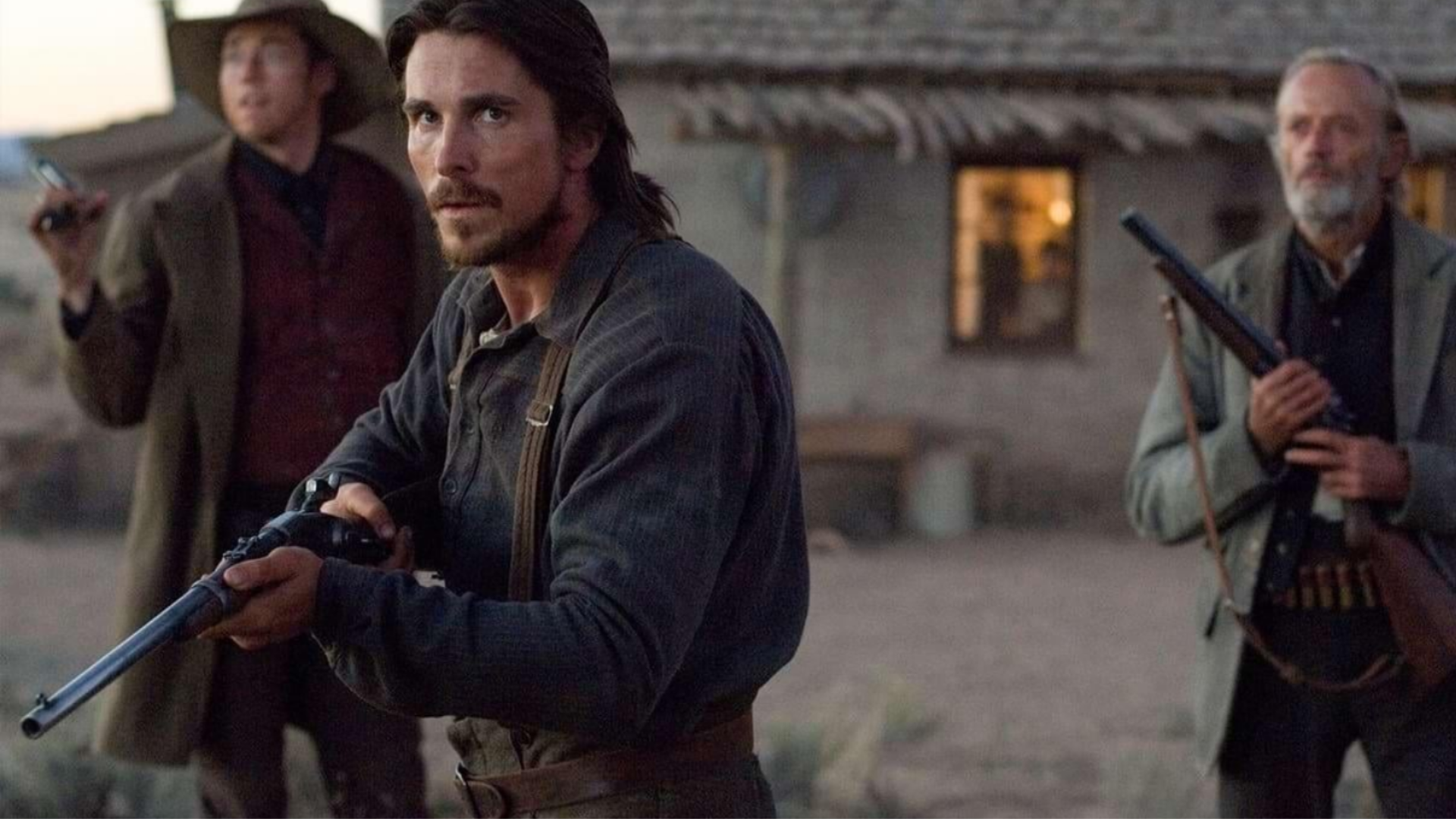
Promotional still from 3:10 to Yuma (2007). © Lionsgate. Retrieved via TMDb.


