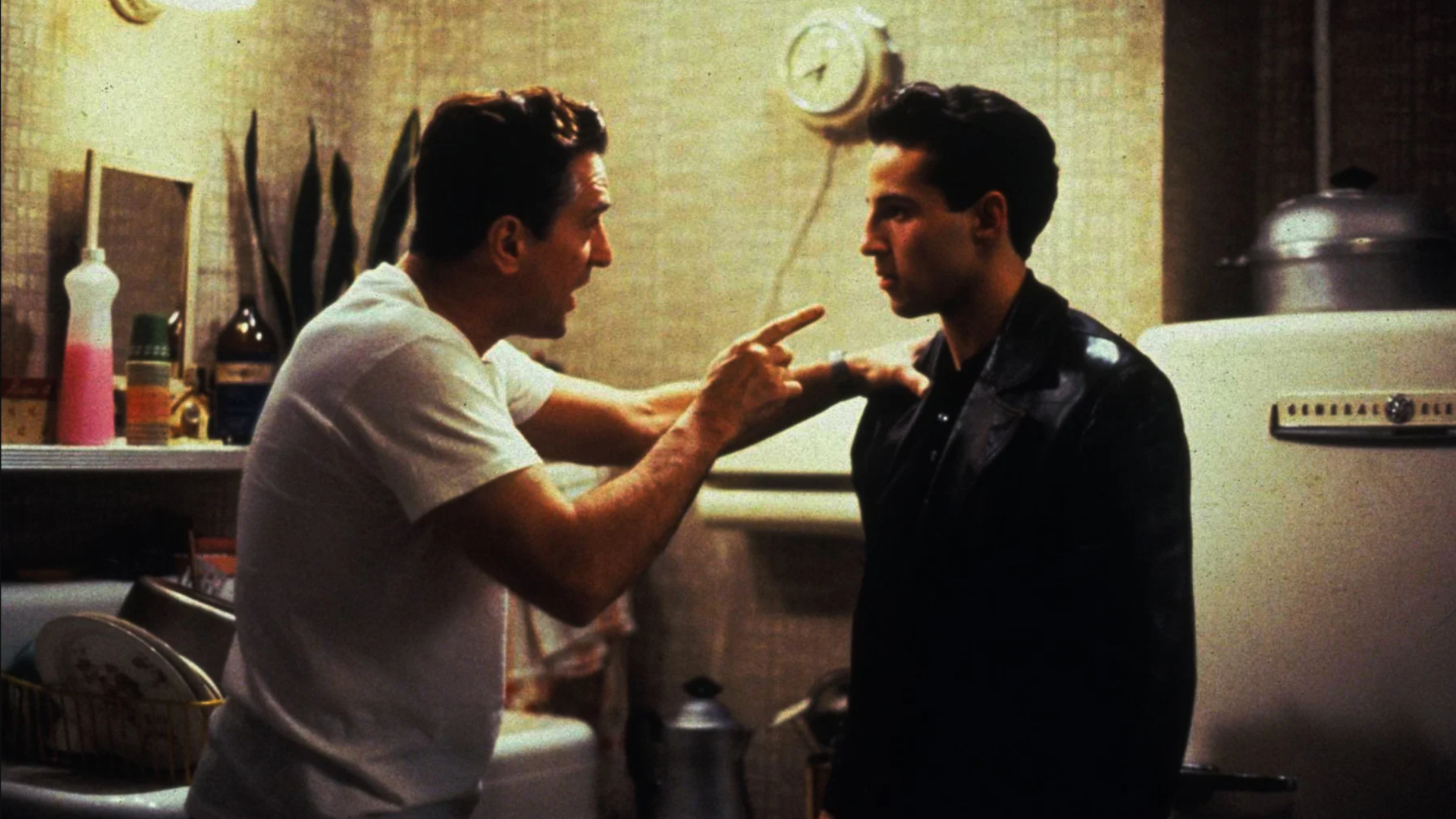
Calogero is a young boy growing up 1950s and 60s New York, in the neighbourhood known as the Bronx. He comes from a working-class Sicilian family, living in the Italian neighbourhood of the Bronx. His father, Lorenzo, is an honest working man who tries to instill in his son the basic hard-working Italian immigrant values which his own father passed down to him. Their life is simple and not too easy, but it is a life that Lorenzo believes he can be proud of – honest hard work, married to the woman he loves, not rich but able to pay for what small pleasures he can. At one point, Lorenzo refuses to move to a better seat at a boxing match: “I like my seat, I paid for this seat” he says. He earns his money by hard work and he can hold up his head at the end of the day.
These are the values he tries to instill in his son, Calogero. Family is hugely important – Calogero is named after Lorenzo’s own father, indicating the importance of the family. Significantly, as Calogero begins to move away from his father and into the world of the Mafia, his name, which every time it is spoken is a verbal reminder of who he is and where he comes from, is shortened to “C”. As he takes on his new identity, this becomes his new name – later on, he will complain to his father when Lorenzo calls him Calogero. Significantly, once Calogero begins speaking with Jane Williams, she tells him that she “prefers Calogero” to “C”. His relationship with Jane will be a path for him away from the life of the Mafia and back towards the values Lorenzo stands for.
Lorenzo constantly tells Calogero that “the saddest thing in life is wasted talent.” He wants the best for his son – this is the reason he drives the bus every day, to support his family. He also tells his son that he should always do the right thing – this is what is most important. Lorenzo exemplifies this advice in his own life – he turns down a job with the Mafia and gives back the money Calogero earned from them, even though his wife wants him to keep the money. The financial pressures on this working-class family are real and difficult, and Sonny and the Mafia offer a way out of that. Calogero gets drawn into it, but Lorenzo refuses to get involved with the mobsters.
Lorenzo’s greatest concern is for his son and the attraction of the local mob boss, Sonny. Calogero, from a young age, is fascinated by Sonny, by the power Sonny seems to wield, by the way Sonny is respected by everyone in the neighbourhood, by the money and the lifestyle. The whole lifestyle, especially that possibility of “being somebody” is dangerously attractive to Calogero – hence Lorenzo’s efforts to keep him away from Sonny’s bar and Lorenzo’s willingness to stand up to Sonny for his son’s sake.
However, the attraction is too strong for Calogero. After witnessing Sonny kill a man, Calogero chooses not to turn Sonny in. For Calogero, “being a rat” is the worst possible crime and so he doesn’t “rat Sonny out.” Calogero doesn’t understand why Sonny killed the man – “was it over a parking space?” – and Lorenzo tells him “you’ll understand when you’re older.”
One of the key themes of the movie, then, is that of “growing up.” Lorenzo doesn’t want to see his son forced to “grow up” too soon by being exposed to the lifestyle of the mobsters. He doesn’t want to have to explain the complexities of the situation to Calogero – “why do you say that it’s a good thing for a bad man,” Calogero asks Lorenzo, and Lorenzo can only respond “you’ll understand when you’re older.” Lorenzo is trying to protect his son from the brutal realities of the world of the mobs and the gangs.
This theme of “growing up” continues as Calogero begins to turn more and more to Sonny as a new father figure. Sonny stands in opposition to Lorenzo as a father – he represents a more glamourous lifestyle. Sonny tells Calogero that the working man is a sucker, that it is better to be feared than loved. Through his interaction with Sonny, Calogero begins to turn farther and farther away from his father. Lorenzo and Calogero had bonded over baseball and the Yankees – however, all it takes is a cynical comment from Sonny (“Mickey Mantle isn’t going to pay your father’s rent”) to change Calogero’s affection for the Yankees.
For Calogero, the life of the gangster holds out greater promise than that of the working man who can hardly pay the bills. However, as he grows older, Calogero finds that there is a third possible way. Sonny is a bad man, but he has a real affection for Calogero. He also knows that the way of life of the gangster is not the place for Calogero – he wants the boy to go to school, to better himself. However, Calogero also has his childhood friends who, like him, idolized Sonny and the mob and have now joined it like him. These young men are ruthless and reckless – they want to fight and kill, to exert their power in violence.
Just as Lorenzo had warned Calogero against Sonny, Sonny now warns Calogero against his friends. Sonny doesn’t want Calogero to become a gangster like him – in his own way, he agrees with Lorenzo that “the saddest thing in life is wasted talent.” Like Lorenzo, he also thinks that Calogero’s talents would be wasted as a gangster. Again and again, Lorenzo warns Calogero about the man he idolizes – Sonny is feared, not loved; Sonny can’t trust anyone, not even Calogero. When Calogero speaks to Sonny about these things, he discovers that it is true – Sonny admits that it is better to be feared than to be loved, and that he can’t afford to trust anyone. It is through learning these things that Calogero is able to grow, able to understand, and able to turn away from the life of the gangster.
Both Lorenzo and Sonny love Calogero in their own way, and both provide for him important lessons. Lorenzo stands for family, for hard, honest work, for doing the right thing. Calogero doesn’t understand this as a child, but is instead attracted by Sonny’s vision of the gangster’s life. However, it is finally through his relationship with Sonny that Calogero learns the truth about what his father meant. Sonny shares many of the same values – he teaches Calogero to care about family, he encourages him in his desire to date a black girl, and he tries to keep him away from the bad company of his friends, even saving his life. If, as was true, Calogero did “a good thing for a bad man”, he also ended up learning good things from that bad man as well.
Very important in all of this, of course, is Calogero’s relationship with Jane. The 60s were a time of great turbulence and violence between races – as we can see in the movie, the Italian neighbourhood and the black neighbourhood are not on friendly terms; each has their violent gangs, and the idea of interaction between white and black is forbidden for many. Calogero however, supported by Sonny, refuses to be intimidated by his racist friends and decides to go out with Jane. This relationship is another way in which he is able to break free of the violence of the mob world.
The story, ultimately, is about Calogero’s growth in understanding – narrating from the perspective of years later, he is able to look back on the formative years of his childhood and young adolescence and see what he owes to the two most important people in his life, his father Lorenzo and his “other father” Sonny. He is able to see the truth of what Lorenzo taught him, which allows him to reject the gangster lifestyle – when Sonny tells him that he can’t trust anyone, Calogero insists that this is not the life for him. On the other hand, Calogero also realizes how much he owes to the bad man, to Sonny, who was for him like another father. Sonny also had valuable life lessons to teach him, even if sometimes the lessons came from seeing how the glamourous lifestyle was not so glamourous after all.
Questions
1. What is it about Sonny that is attractive to Calogero? Why is Lorenzo afraid of this attraction?
2. Sonny insists that “the working man is a sucker.” What does he mean by this? How would Lorenzo respond to this claim?
3. By the end of the movie, what are the lessons that Calogero has learned from Lorenzo and from Sonny?
Promotional still from A Bronx Tale (1993). © Savoy Pictures / Tribeca Productions. Retrieved via TMDb.


