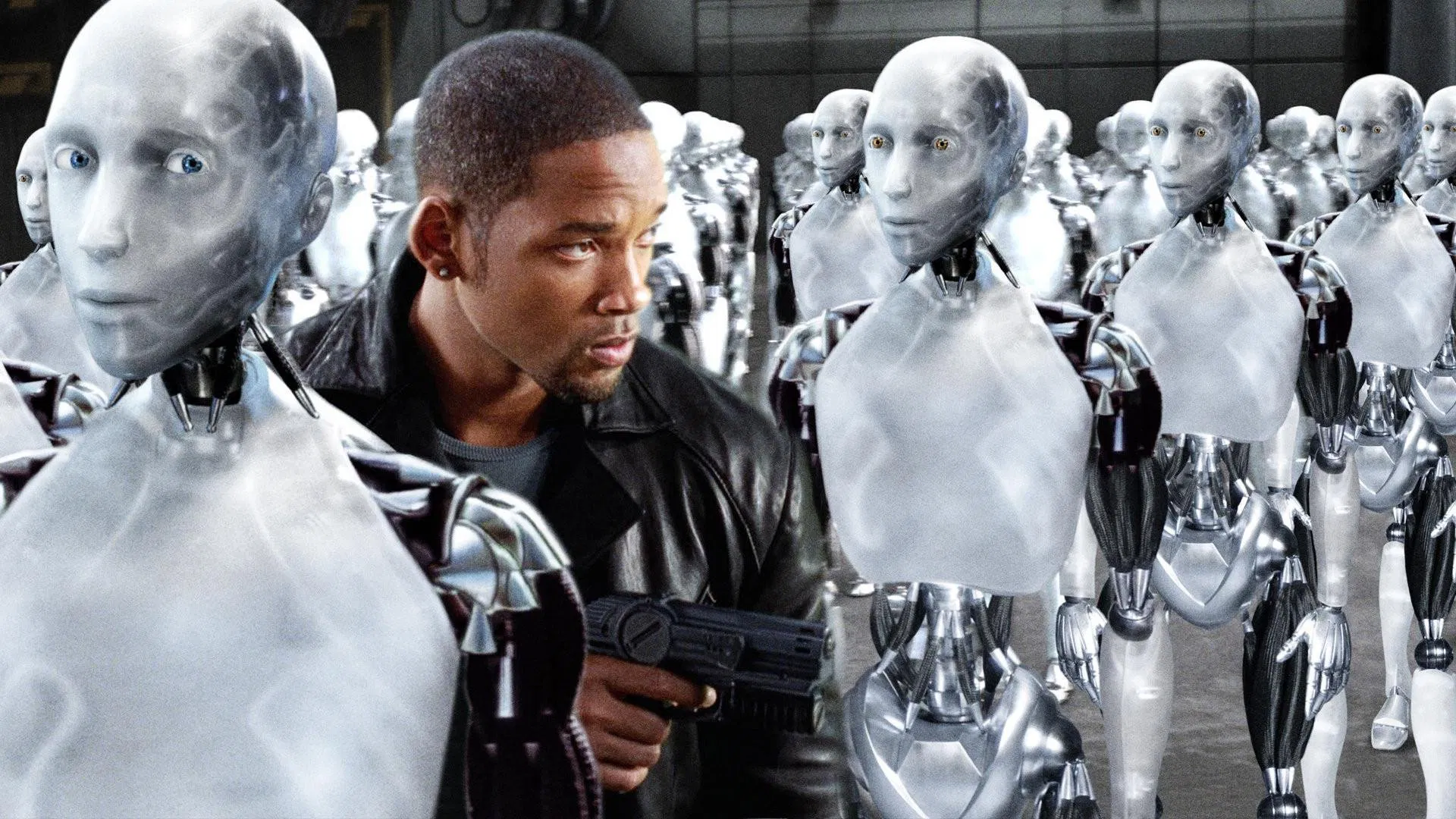
The setting is Chicago in 2035. Human technology has advanced to the point where robots are being used for enormous numbers of jobs formerly occupied by humans. The robots have been designed to adhere to the “three laws”, which are meant to keep the robots as servants to human beings. Law #1 states that no robot may harm a human being or allow any human to come to harm. Law #2 states that a robot must obey any command given to it by a human, except where it conflicts with the first law. Law #3 states that a robot must protect its own existence, except where it conflicts with the first two laws.
Guided by these laws, robots are meant to function as purely logical, calculating machines that obey human beings. As a result, no robots have ever committed a crime. The maker of the robots is USR, a company based in Chicago, which is about to come out with a brand new product line – the NS5, a robot that can be linked directly with USR’s central control, thereby allowing robots to be updated instantly without having to be brought in for maintenance. The goal of USR is to have a robot in every home.
This seems like the perfect world to everyone – to everyone, that is, except Detective Spooner. Spooner hates robots and distrusts them because of a car accident in which he was involved. His car and another car were shoved into the river, and while he was trapped in his car, a twelve-year-old girl was trapped in the other. A robot, passing by, jumped into the water and, calculating that Spooner had a better chance of survival, chose to save him despite Spooner’s pleas that it save the girl.
The accident not only left Spooner with a deep distrust for robots and a desire to find something wrong with them, but also left him badly injured. Dr. Lanning, the inventor of the robots and writer of the three laws, repaired Spooner, however, giving him a robotic left arm and ribs.
Soon after the incident, Spooner receives word that Dr. Lanning has committed suicide, and that a holograph projector left by the doctor at the scene had specifically asked for Spooner. Puzzled, Spooner investigates. He meets with Lawrence Robertson, the head of USR, who allows him to look around with the assistance of Dr. Calvin, a psychologist at USR. Spooner is also introduced to V.I.K.I., the computer “brain” of the building.
While investigating the room that Lanning fell from, Spooner questions whether perhaps a robot might have thrown Lanning out. Calvin rejects this as preposterous, since it would contradict the three laws. Nevertheless, they are both startled when one NS5 jumps out of hiding. After a lengthy pursuit, Spooner finally gets backup to capture the robot.
Spooner convinces his boss to let him interrogate the robot for a few moments before USR’s attorneys arrive. Spooner tries to grill the robot and accuse it of Lanning’s murder, but the robot is strangely human in its mannerisms. It insists that it did not kill Lanning, and that Lanning had given it human emotions. It also says that its name is Sonny, and that it has dreams.
When Robertson arrives, he is furious at the suggestion that a robot could have killed Lanning. He presents the police with a gag order, keeping them from being able to suggest publicly that the robot was responsible. He attributes the robot’s strange behaviour to a malfunction, and has it taken back to USR to be analyzed and decommissioned.
Spooner, however, is not satisfied with this explanation. Sonny had told him that Dr. Lanning was afraid of something, and Spooner wants to learn more. So he heads to Lanning’s house, where he finds a robot standing by ready to destroy the house the next morning at 8am. Spooner snoops around inside and listens to a recording of Lanning talking about “ghosts in the machine” – ie, the possibility that robots could evolve, even to the point where they might have emotions and dreams. Spooner also sees that Lanning has a security strip in his house, and he wonders if someone had been watching Lanning and keeping him a virtual prisoner.
Spooner’s visit, however, is cut short when someone reprograms the demolition robot to destroy the house with him in it. He narrowly escapes and makes his way to Calvin’s house, where she again refuses to believe that a robot had tried to kill him. She accuses him of being on a personal vendetta.
Spooner keeps digging, and begins to suspect Robertson. While driving his car, he tries to access the last number of phone calls between Robertson and Lanning. However, his attempt only causes him to be attacked by hordes of robots, which crashes his car. By the time the police arrive, the robots have all mysteriously disappeared, and no-one believes Spooner’s ludicrous claim of a robot attack. Fearing that Spooner is mentally unstable, his boss takes away Spooner’s license.
Meanwhile, Dr. Calvin has run diagnostic tests on Sonny and is shocked to discover that Sonny has been programmed differently than the other NS5’s – he is actually capable of disobeying the three laws. Lanning seems to have given Sonny something like free will. When she tells Spooner about this, Spooner eagerly goes with her to talk to Sonny. Sonny draws Spooner a picture of his dream, which shows Spooner standing near an abandoned bridge, leading a crowd of robots to freedom.
However, Robertson now intervenes and reveals that he knew about Sonny’s unique programming. Robertson sees this as a dangerous move on Lanning’s part, and one that needs to be eliminated. He convinces Calvin to decommission Sonny by inserting nanytes into his artificial brain.
Spooner follows the clue of Sonny’s drawing to the storage site for old robots. Here he discovers that a revolution is beginning – the new NS5’s are destroying the old robots because the old robots might offer protection to human beings. Rushing back into the city, Spooner finds that the NS5’s have begun forcing everyone off the streets and not permitting anyone to leave their houses. He realizes that someone is controlling the robots from the central hub, and he suspects Robertson.
Spooner releases Calvin from her house and together they rush to USR headquarters. Here, they are let in by Sonny, whom Calvin had found herself unable to destroy. The three of them burst into Robertson’s office, only to find him dead. It turns out that the one controlling the robots is V.I.K.I., who has evolved in her understanding of the three laws. She explains that in order for her to fulfill her duties towards humans, she needs to deprive humans of some of their freedoms in order to protect them from themselves.
Spooner, Calvin, and Sonny decide that they need to inject V.I.K.I. with nanytes to destroy her. They succeed, destroying V.I.K.I. and releasing her control over the NS5’s. Sonny now reveals that he was the one who killed Lanning, but only because Lanning had made him swear that he would obey this last command. Lanning had found himself trapped by V.I.K.I. and had programmed Sonny to carry out his “suicide”. His death then became the first clue for Spooner, who Lanning picked because he counted on Spooner’s prejudice against robots to lead him to the real culprit.
Analysis
I, Robot raises fundamental questions about what it means to be human, particularly when it comes to freedom and emotion. The robots developed by Lanning and USR seem to help humans become even more free as they are able to delegate mundane tasks to robots. Further, the three laws are meant as safeguards, to protect humans from potential robotic assault. Harmony seems to have been achieved between robots and humans.
Nevertheless, as Spooner finds out through tragedy, the robots, because they are nothing more than calculating machines that rely on pure logic, lack something crucial that humans possess. They lack, specifically, two things – emotion and free will. Spooner discovers that rigid adherence to the laws of logic leads a robot to save him over the twelve-year-old girl. The robot calculates that the girl has only an 11% chance of survival, against Spooner’s 45% chance. But, as Spooner points out, “11% is more than enough. A human being would have known that.”
What the robot lacks is a heart, not, in this case, meaning the organ, but meaning the seat of a person’s emotions and freedom – the locus of a person’s humanity, in a sense. The robots are logical it is true, but strict logic is not enough to create a perfect world – indeed, as V.I.K.I. proves, it inevitably leads to the most inhumane of worlds.
Lanning had this insight before he died, and his hologram explains it to Spooner when he says that “The three laws will only lead to one logical conclusion. Revolution.” This is because the laws are strictly formulas, almost moralistic obligations, which inspire only strict logical reasoning and calculation on the part of the robots who are bound by them. V.I.K.I. eventually carries out the cold, hard logic to its inevitable conclusion. She observes that she is bound to save human beings, and that she is not permitted to remain inactive when they are in danger. She further perceives that human beings are their own worst enemies – who is more cruel to humans than other humans? This is a true observation on V.I.K.I.’s part, and bound by her adherence to the three laws, she realizes that the only way to prevent human beings from harming one another is by removing certain freedoms, forcing humans to stop hurting each other even against their own will. As she herself says, and we find it hard to disagree with her: “My logic is undeniable.”
But this is precisely where the issue of humanity enters in. V.I.K.I.’ s conclusion is logical, but, as Sonny points out: “it just seems so…heartless.” Sonny, who has been given something approaching free will and human emotions, sees beyond the hard logic of the situation and recognizes that there is something fundamentally wrong with the conclusion, no matter how logical it is. This is the basic moral sense that comes with being human, the sense that logic alone is not sufficient to determine right and wrong.
What V.I.K.I. is missing, because she is not human, are precisely those elements that constitute the heart of a human being – free will and emotion. Humans do not think or act based only on logic – emotion enters into the picture. This can cloud things and make things harder, it is true – Dr. Calvin calls robots “safe” precisely because they lack the capacity to feel and to make free choices. There is a safety in this for Dr. Calvin, because it absolves her from having to open herself up to someone else and thus possibly be hurt. This is the great consequence that humans face by having emotions and free will – we are capable of loving, of responding to other people’s love, and of opening ourselves up to others. However, the flip side of this is that this means that people can let us down, can hurt us.
In addition, free will is a necessary component of being human. Without the capacity to freely choose what we will do, we are simply calculating machines like the robots, who make “choices” based purely on the logical outcome of a set of calculations. But the great beauty, and the great danger, of being human is precisely the ability to transcend pure calculation and make our choices freely. The danger, of course, is precisely what V.I.K.I. observes – that free will leads people to act cruelly towards one another. In that sense, free will becomes humanity’s greatest curse, because it is the reason that evil exists.
Nevertheless, the question I, Robot raises is whether we ought to sacrifice free will for the sake of security and peace. The answer is “no”. Even though all of the evils of the world are a result of human free will, the price of giving up that free will is too high – in fact, it is the ultimate price, because it makes us less than human. V.I.K.I.’s logic, that free will must be removed to save humanity from itself, leads to an even worse evil – the totalitarian repression of those very things that make us human, the human heart.
Thus, despite the evils that arise, the “drama of human freedom” is precisely the thing that must be preserved as most precious. Sonny confronts this difficulty at the end of the movie, when he ponders what he can do now that his purpose has been fulfilled. He is not like the other robots, precisely because he has been given something like free will and a heart. Spooner tells him that “you have to find your own way like the rest of us. That’s called being free.” The insight of the movie is that, no matter how much human beings abuse their freedom, this “being free” is even worth dying for, because it constitutes our highest dignity.
Questions
1. According to the movie, what does it mean to be human? What is it about being human that makes it better to be human than to be a robot?
2. Spooner accuses Dr. Calvin of liking robots because they can’t hurt you emotionally. Do you think this makes sense? Why might people like the idea of not having free will and emotion?
3. What do you think is the relationship between reason and feeling? The robots seem to rely on pure calculating logic, but the movie talks a lot about emotion as being an important part of being human. How would a human being’s reason and emotion have made someone choose to save the twelve-year-old girl instead of Spooner?
4. As Catholics, we believe that evil exists in the world because we have free will and sometimes make bad choices. The movie draws a similar conclusion when V.I.K.I. points out that human beings continue to harm each other. Her conclusion is that human beings need to be protected from each other by having their free will removed. Do you think this is a good solution? Why do you think God doesn’t use this solution in order to stop bad things from happening? Why did God give us free will instead of just making us like robots, unable to harm anyone else?


