Synopsis
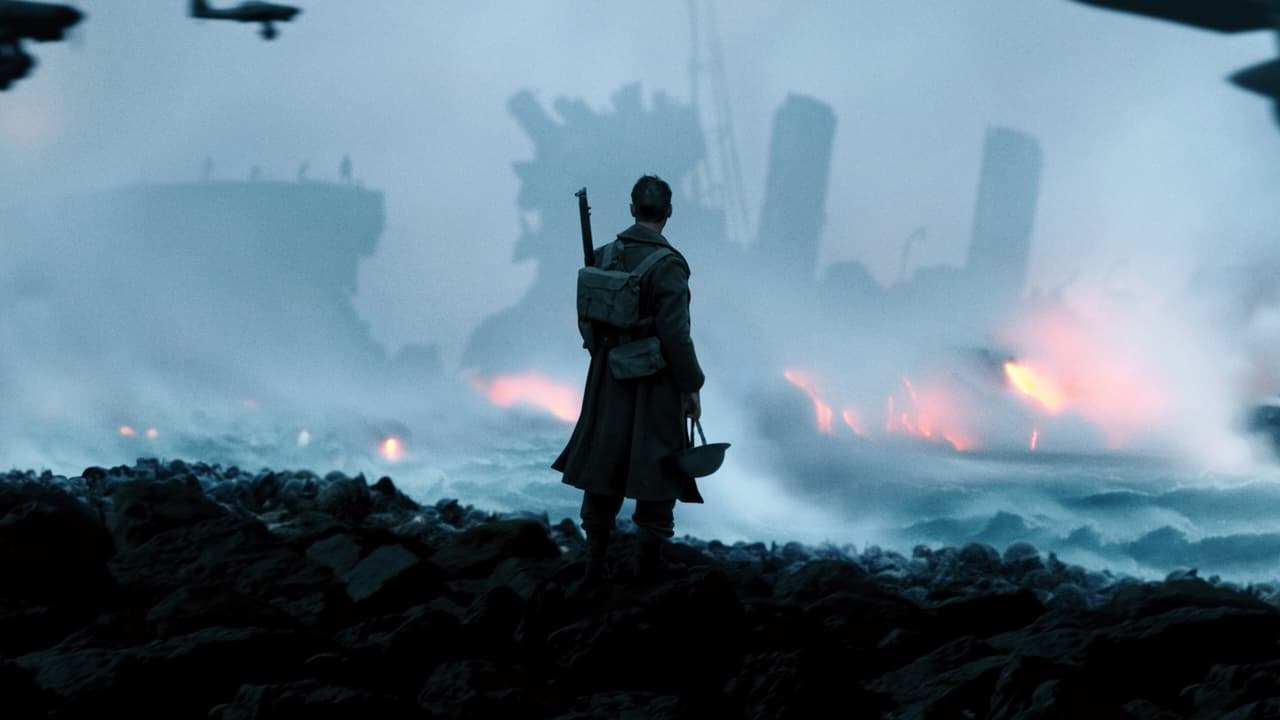
As German forces close in on Allied troops stranded on the beaches of Dunkirk in the spring of 1940, hundreds of thousands of British and French soldiers await evacuation with little cover and dwindling hope, the story told across three intersecting timelines: a week on land, a day at sea, and an hour in the air. On the beach, a young soldier named Tommy struggles simply to survive and find passage home, latching onto any opportunity, honest or not, to escape the exposed shoreline, including briefly posing as a stretcher-bearer and later joining a fearful, silent Scottish soldier in a series of increasingly desperate attempts to board any departing vessel.
At sea, civilian boat owner Mr. Dawson sails his small pleasure craft across the Channel himself, alongside his teenage son Peter and a local boy, George, to help rescue stranded soldiers, refusing military requisition in order to captain the mission personally. Along the way they rescue a shell-shocked soldier who, in his panic, causes an accident that gravely injures George, and who reacts with volatile shame once he realizes what his fear has cost, testing Dawson’s composure and quiet resolve to continue the mission regardless.
In the air, RAF pilot Farrier fights to protect the evacuation with dwindling fuel and a damaged instrument panel, forced to estimate his remaining flight time by eye alone. He ultimately sacrifices any chance of his own safe return, gliding his plane to continue shielding the ships and soldiers below for as long as possible even after his fuel is certainly exhausted, while the massed civilian boats of the “Dunkirk armada” arrive at last to carry home an army that could not save itself alone.
Analysis
Survival Without Glory
Much of the film follows Tommy simply trying to stay alive, sometimes through means that are less than heroic – queue-jumping ahead of wounded men, evading duty, briefly abandoning a wounded soldier when a boat’s survival seems to depend on lightening its load. The film refrains from moralizing about this, presenting ordinary fear and self-preservation with unusual honesty for a war film.
This honesty matters because it makes the acts of genuine sacrifice elsewhere in the story land with far greater weight by contrast. A film populated entirely by unblemished heroes would make sacrifice look easy or automatic; by showing how tempting mere survival can be, the film clarifies what it actually costs certain characters to choose something more than survival.
Ordinary People Answering an Extraordinary Call
Mr. Dawson is not a soldier, and nothing requires him to risk his own boat and his son’s life to cross the Channel into an active warzone. His quiet insistence on sailing the boat himself, rather than surrendering it to the navy as officially requested, embodies a form of civic virtue that asks nothing in return and expects no recognition – ordinary competence and courage placed directly in service of people he has never met and will likely never see again.
His steadiness is tested severely when the shell-shocked soldier’s panic leads directly to his own son George being fatally injured below deck. Dawson’s refusal to turn back, and his later refusal to let the soldier be blamed publicly, reveals a man whose sense of duty extends even to protecting a frightened stranger from the consequences of a fear Dawson understands all too well.
Sacrifice Measured in Fuel and Time
Farrier’s heroism is almost entirely a matter of arithmetic: how much longer he can stay in the air, on dwindling and eventually unknown fuel reserves, to protect the ships and men below before he himself is stranded, shot down, or forced to ditch. His choice to remain past the point of any safe return for himself, gliding silently once his engine finally cuts out, is one of the film’s clearest images of a man spending the last of what he has for people he will never meet.
The quiet, almost peaceful manner of his final flight – no dramatic music, no words, simply a man doing exactly what he set out to do until he no longer can – reframes sacrifice not as a single explosive act but as a sustained, disciplined commitment carried through to its natural end.
A Nation’s Shame Turned Toward Gratitude
Tommy and his fellow soldiers, upon finally reaching English shores, expect scorn for what feels to them like a defeat rather than a victory – they have, after all, been rescued rather than triumphant. Instead, they are met with blankets, food, and newspapers celebrating their survival, a reception that startles and unsettles men who cannot yet see their own ordeal as anything but failure.
This gap between the soldiers’ private sense of shame and the public’s genuine gratitude speaks to something true about how those who suffer often cannot see clearly, in the moment, what their survival and endurance actually meant to the people who depended on it – a gap that closes only later, and only partially, for men still carrying the war within them.
Questions for Discussion
1. Tommy behaves at various points in less than heroic ways simply to survive. Why might the film choose to portray fear and self-preservation so honestly, rather than presenting every soldier as brave?
2. Mr. Dawson insists on piloting his own boat into a warzone rather than surrendering it to the navy. What do you think motivates this insistence, given the real danger to himself and his son?
3. Farrier chooses to stay in the air past the point of safe return in order to protect the evacuation. What does this decision cost him, and what does it accomplish?
4. The film tells its story across three different timescales – a week, a day, and an hour. What does this structure suggest about how differently danger and sacrifice are experienced depending on one’s role?
5. Is there a meaningful difference between the courage shown by soldiers under direct orders and the courage shown by civilians like Mr. Dawson who choose to help freely? Explain your view.
6. What does the arrival of the civilian “little ships” suggest about the relationship between an army and the ordinary people it exists to protect?
7. Tommy’s survival depends at several points on the sacrifice of others he barely knows. What obligation, if any, does his survival place on him afterward?
8. The film largely avoids showing the enemy directly, focusing instead on the experience of those trying to survive and rescue others. What effect does this choice have on how you understand the events depicted?
9. Dawson refuses to let the shell-shocked soldier be blamed publicly for George’s death. What does this refusal suggest about how he understands fear and its consequences?
10. The soldiers expect shame upon returning home but are met with gratitude instead. What does this gap suggest about the difference between how we judge our own failures and how others perceive our endurance?


