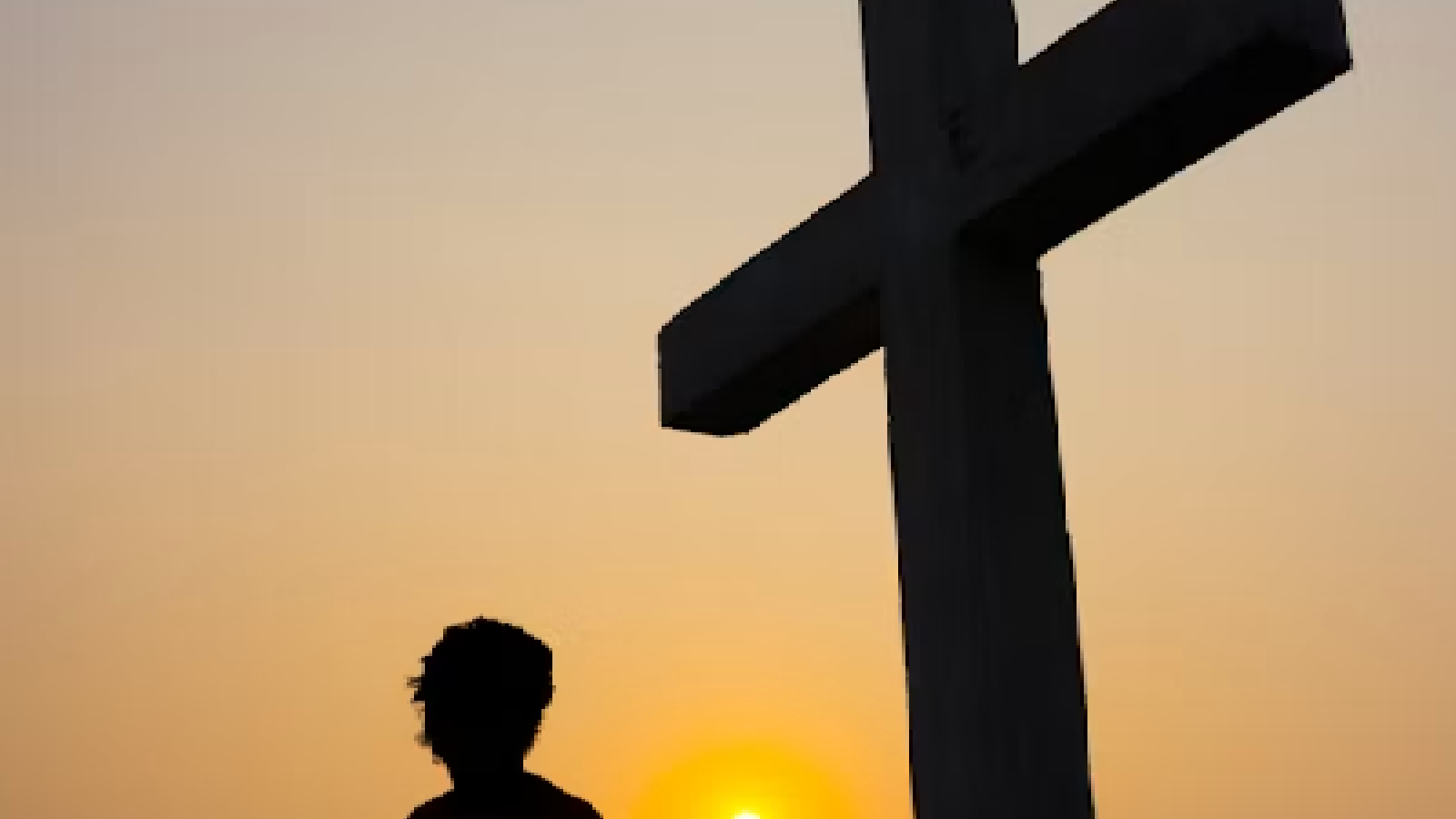
But more — the Cross as such towers ineluctably over the life of every Christian. Through Christ, suffering has acquired an entirely new meaning. What was merely an inexorable consequence of original sin before Christ has now assumed the character of a fruitful penance and purification— a manifestation of love. Suffering love has redeemed the world. The cross stands forth as the symbol of redemptive and expiatory suffering freely accepted by merciful charity.
No one who is unwilling to take up his cross can truly follow Christ. In the life of every Christian, that cross is there. Not unless he embraces it with eager readiness — perceiving in it the call of God and accepting it as a means of his mortification — can he be transformed in Christ.
To evade the cross is to evade Christ. Whether we try to escape from it in fact, to hide it from our eyes, or to bury it under a layer of shallow pleasures and peripheral interests — it is Christ from whom we thus separate ourselves. “But it behooves us to glory in the cross of Our Lord Jesus Christ: in whom is our salvation, life, and resurrection: by whom we are saved and delivered,” the Church sings in the Introit of the Exaltation of the Holy Cross. Again, in Passion Week: O Crux, ave spes unica, hoc Passionis tempore (“Hail Cross! thou only hope of man, Hail on this holy Passionday!”),Venantius Fortunatus, Vexilla Regis.
Only he who “lives by Christ” can fully bear his cross
Our nature, to be sure, struggles against the cross: we seek to flee from it. Sometimes we achieve this purpose to a degree by keying down our life to a lower standard, and appeasing our desire for happiness with more trivial goods.
If, on the one hand, this success in eschewing the cross can never be but a partial and largely an illusory one, on the other hand it again requires a great deal to experience one’s cross to the full. He alone who “lives by Christ” is able to bear the whole weight of a heavy cross — to endure it integrally; to realize all the suffering it implies. He alone, above all, is able so to cling to it as to make the cross, as it were, carry him. He alone is able to carry it in full inward peace and unity: without recalcitrance or despair, without even the bitterness of emphatic resignation.
For to him, and him only, it means the gift of a participation in carrying the holy Cross of Our Lord. He endures crucifixion with Christ. He hails the cross as a possibility of expiation for his own and also for others’ sins, a means of the purification he is allowed to undergo by God’s mercy. To die to himself in order to be reborn in Christ is what he desires. He knows that all death is painful — that without the cross and suffering he cannot die to himself. For the Lord has said: “If any man will come after me, let him deny himself and take up his cross and follow me” (Matt. 16:24).
Properly bearing our cross unites us with Christ
Such a true Christian may not, as did certain saints, seek for suffering. This requires a special vocation. The cross that God sends him, however, he must in love be ready to welcome: O Crux, ave spes unica. He may pray that he be spared the cross, saying with Jesus, “My Father, if it be possible, let this chalice pass from me” (Matt. 26:39), but not without adding as Jesus did, in a spirit of ultimate acquiescence in the will of God: “Nevertheless, not as I will but as Thou wilt.”
For it is out of love that God sends our cross to us; and it is destined to prepare the way for a deeper love for God. So long as
God does not take the cross from us, we must feel it as a participation in the Cross of Christ, as a costly treasure, as a divine gift of mysterious fruitfulness. In bearing our cross, we are placed in contact with Christ suffering out of charity. We should bring ourselves to recognize in our cross the countenance of the suffering Savior; to experience the nearness to Christ implied in its acceptance. Blessed are all those who bear a cross, for they shall be comforted: as St. Paul says, “As you are partakers of the sufferings [of Christ], so shall you be also of the consolation” (2 Cor. 1:7).
“Blessed are they that mourn: for they shall be comforted.” These words illuminate the holy paradox of our terrestrial situation. Blessed are, not those unaware of the cross, not the spoiled children of fortune absorbed by a life that is all sunshine and enslaved to a gigantic illusion even to the moment of death — but those who recognize, and suffer from, the strife between God and the world; who embrace their cross and share in the Cross of Christ, the Conqueror of that strife.
Yet, God’s existence should fill us with overwhelming joy
And yet it is holy joy which must fill us above all. We must bring to full fruition in us the words of St. Paul: “Rejoice in the Lord always: again, I say, rejoice.” Indeed, even in our torn state on earth we have more reason to rejoice than to grieve. For God, the Sum of all values and Paragon of all glory, is also Reality absolute, and the primal Cause of all being.
Our response to the world is a false one unless it is adequate to the true order and hierarchy of being. Many as are the things in the world which demand as an adequate answer the response of sorrow, the absolute and ultimate reality, preeminent above everything else, demands on our part the response of joy.
So infinitely high does the fact that God exists rank above all the rest, that our response to that fact, too, must infinitely surpass in weight all our other responses. As all finite being is a mere empty shadow of Being infinite and absolute, so also does all imperfect ion and disharmony of this valley of tears shrink almost to nothing if viewed in the perspective of the infinite glory and harmony of God. Thus is our cause for joy incomparably greater than for sorrow. Therefore, we understand that notwithstanding the cross and all sorrows inherent in earthly existence, the Apostle says, “Rejoice in the Lord always.”
God’s redemption of mankind is a further reason for overwhelming joy
But this holy joy, overshadowing all sorrow, which prompts the Church to sing in the Gloria in excelsis, “We praise Thee; we bless Thee; we adore Thee; we glorify Thee; we give Thee thanks for Thy great glory” — this jubilant rejoicing could never blossom in our souls unless the gulf that separates us from God were bridged by God; unless the burden of guilt that weighs down man (whose nature is tainted by original sin) were removed by the mercy of God.
Our redemption by the God-Man Christ, who has burst our chains and restored us to communion with God, is what provides us with an actual warrant for our joy.
Nor must this holy joy over the incarnation of God and our redemption — this bliss which finds its highest expression in the Exsultet of Holy Saturday but pervades the entire Liturgy in innumerable variations — ever leave us. For the many things that evoke in us a justified sorrow, taken all together, are nothing if contrasted with this blissful reality. Our cause for this holy joy always retains its central and paramount position in relation with all things, nor can it ever become a matter of secondary interest Therefore the Apostle says, Iterum dico vobis, gaudete (“Again, I say, rejoice”).
Though our redemption is a necessary condition of our delight in the glory of God, though only the redeemed can properly give thanks for it —Gratias agimus tibi propter magnam gloriam tuam — the primary object to which our joy adequately refers is not our deliverance and elevation, but God Himself, His glory as such, His infinite goodness which reveals itself to us in Jesus’ face.
But in the second place, our redemption and our undeserved privilege of being called to an eternal communion with God justify, on our part, an indestructible holy joy — a supernatural joy which is to fill our eternity. “Thou hast redeemed us, O Lord, in Thy blood, out of every tribe and tongue and people and nation, and hast made us to our God a kingdom. The mercies of the Lord I will sing forever” (Introit of the Feast of the Most Precious Blood of Our Lord).
We should also rejoice about God’s gifts of grace to mankind, and for the Church
We have, further, an occasion for unending joy in every one who has been transformed by grace, who can say of himself with St. Paul, “The grace of God was not without effect in me”; who bears the seal of Christ on his forehead and in his whole life. Therefore does the Church sing in the Introit of All Saints and of all great feasts of the saints: “Let us all rejoice in the Lord, celebrating this feast.”
We must also rejoice in God’s gifts of grace, which change even our earthly habitation into a forecourt of heaven: notably, the Sacraments, and above all, the Holy Eucharist. “He fed them with the fat of wheat, alleluia; and filled them with honey out of the rock, alleluia, alleluia, alleluia” (Introit of the Feast of Corpus Christi).
Again, do we not find an enduring cause for joy in the existence of the Holy Church, the Bride of the Holy Spirit; in her infallible doctrinal authority; in the supernatural community of the Mystical Body of Christ? In these things, every Christian must take constant delight, however heavy his cross, however much his personal life may abound in suffering. All terrors and all the woes of the world are powerless to destroy these goods; the joy they inspire soars victoriously above all sorrow.
Christian hope infuses even our sufferings with joy
Yet, evidently an objection might be raised. Is not our incertitude as to whether we shall persevere and partake in the fruits of Redemption, a drop of wormwood which might poison all this joy? Had we not better bear in mind the words of St. Augustine, “He who made thee without thee will not justify thee without thee”? True enough, the hour of eternal holy joy — joy pure and untroubled, joy unceasing and indestructible — has not yet struck for us. The Lord has not yet spoken to us the words: “Well done, thou good and faithful servant: enter into the joy of thy Lord.” We still dwell in this life, and our situation is still fraught with the character of duality.
However, all our sufferings are transfigured by a ray of light; a light of vivifying solace is spread about everything that would, in itself, legitimately fill us with anguish and sorrow. That light is hope. It is our right, it is our duty to hope: for hope is one of the three theological virtues which are to inform a Christian’s life. Hope, illuminating everything like a shaft of light that pierces through darkness, rectifies and sweetens all sorrow in its innermost core.
So long as we are in statu viaewe still live in hope. This means that the eternal morning has not yet dawned: that we have not attained the Goal but are as yet on our pilgrimage. But it means, also, that we already possess hope itself: that, in other words, joy has already virtually conquered all suffering. For we do not hope in the sense of a vague, obscure, halfhearted expectation. Ours is a radianthope, a firm hope founded on the word of God and the fact of Redemption. And the possession of this Christian hope — a response to the goodness and the revealed truth of God — is in itself an incomparable treasure of happiness.
Therefore, although there is plenty of reason for sorrow, and although our sorrow is not only excused but exalted: “Blessed are they that mourn,” a Christian on his earthly pilgrimage must never live “as though he had no hope.” In the first place, since there is an infinitely greater reason for joy than there is for sorrow, joy must keep its primacy over sorrow. Secondly, the cross of earthly life — all pain and all sorrow, that is — should be illumined and transfigured by hope. “That you be not sorrowful even as others who have no hope,” says St. Paul (1 Thess. 4:13).
We should rejoice even about the natural gifts of God
But neither must the suffering we have to undergo in this valley of tears prevent us from gratefully enjoying the numberless natural gifts of God, particular to us and common to all, with which our lives are blessed. Neither our own suffering nor that of others must be allowed to blind us to the splendor of sunlight, to the beauty of the sky and the stars; to the bliss of loving and being loved; to the greatness of the truths we may penetrate. It would be ungrateful of us, and an unfitting answer to the liberality of the “Father of all lights,” were we to abstain from delighting in all the grandeur and beauty in the world which tells us of God and is destined to elevate us to Him.
Let us admit, though, that God may burden us with a cross — such as the loss of one who is dearest to us — which withers up all joy about creaturely things in our heart, and transforms our life into a pure via Crucis. Even then, however, our supernatural joy because of God and because of the glory that awaits us in eternity and is the object of our wistful hope must remain alive in us, and keep its primacy.
In the life of St. Francis of Assisi, we find this grateful joy at every gift of God wonderfully united to a deep sorrow over the disharmony of this valley of tears. His attitude expresses in an exemplary way the right response of man to the dual aspect of terrestrial life. The same one who shed so many tears over his sins and whose heart was pierced by pain because “Love is so little loved,” with his eyesight almost gone and his body all but completely broken, was to write the Canticle to the Sun, that superb paean of joy.
Christians must interweave their lives with true sorrow, but with even greater joy
It would be a great error, then, to deny that a Christian should be glad of the creaturely goods, too, which he owes to God’s munificence: as though the precariousness of our situation on earth and the ocean of sufferings in the world forbade us to enjoy the blessings God has accorded to each of us. No, we should always display a full and adequate response to God and to everything He sends us.
Is it suffering; is it the cross? Let us readily acquiesce in His holy will, yet always sustained and consoled by hope, and aware “that the sufferings of this time are not worthy to be compared with the glory to come, that shall be revealed in us” (Rom. 8:18).
Again, if joy is what falls to our lot, we should appreciate it gratefully, and take an unrestrained delight in the bounty of God, without however allowing our happiness to make us forgetful of the unchangeable gravity of our earthly situation.
In brief, a true Christian must not live in a way as though Christ had never spoken the words, “Blessed are they that mourn,” hut even less in a way as though He had not also said to His disciples, “Be glad and rejoice, for your reward is great in heaven.” The Christian knows: “Pain and suffering are only there for the sake of joy.” (Father Heribert Holzapfel, O.F.M., “Freude”)
The tissue of a Christian’s life must be interwoven with threads of true joy and threads of true sorrow alike, because we have not yet arrived at the point “where God shall wipe away all tears.” But it is joy that must have the primacy: for, after the lumen Christi has brightened the world, even on earth there is incomparably more cause for bliss than for sorrow. Joy must be the deeper, the decisive element, the form of our life, as it were. For that which warrants our joy is the supreme reality, the ultimate word in the universe. The sufferings of this world are essentially transitory. Happiness, eternal and indestructible, awaits all those who follow Christ.
However dark the griefs and terrible the sufferings a Christian may know, over and above them soars the triumphant luster of joy. This is the spirit of the Liturgy. With all its mournfulness, Passion Week leads up to the definitive and ultimate reality of Easter: the soaring beatitude transcending all time; and from the latter is derived the keynote of the Liturgy of the whole year. The seasons of alleluia far outweigh those in which alleluia is not sung. Even during the time of Advent and of Lent, a ray of hope, and with it of joy, is never absent.
To the Church, which sees everything in the light of eternity, joy is the superior and consummate reality. “So also you now indeed have sorrow; but I will see you again and your heart shall rejoice; and your joy no man shall take from you” (John 16:22).
By Dietrich von Hildebrand
Photo by Daniel Joshua on Unsplash


