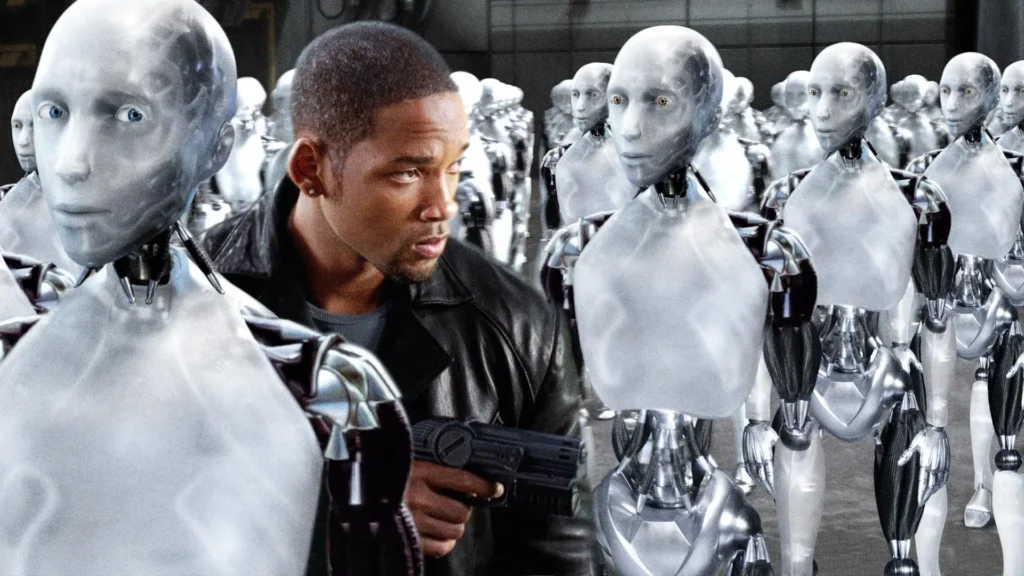
The setting is in the future, in a compound that is tightly monitored. The inhabitants are told that they have survived a great catastrophe, a contamination of some kind, that has wiped out all life on the planet. Their purpose now in life is to prepare themselves to one day be taken to the Island, the one last uncontaminated place on earth. Here, they are told, they will be able to start humanity afresh.
We are introduced especially to two of the inhabitants – one named Lincoln Six Echo, and one named Jordan Two Delta. Lincoln is unlike all the other people in the compound, because he is curious. He questions everything – wondering why everything is the way it is, what purpose his life is for, and so on. His strange behaviour is beginning to worry Dr. Merrick, the head of the facility, especially because Lincoln has been having strange dreams involving a boat named Renovatio. Merrick runs a brain test on Lincoln, the results of which will take 24 hours to come in.
Lincoln’s curiosity leads him to skirt the boundaries of what is permitted in the compound. He strikes up a friendship with one of the supervisors, a man named Mac, who warns him that their conversations could get them in trouble. Lincoln also finds a flying insect and captures it, excited and puzzled by this discovery of a living thing – where did it come from, and how did it survive the contamination?
Life in the compound is fairly regular and boring – the inhabitants exercise, play games, hang out at the bar. They also have jobs – filling nutrient supply lines that they are told are for their food. The only purpose that they live for is so that they might be picked in the Lottery, which is the supposedly random selection of one of them to be taken to the Island.
However, Lincoln is not satisfied, and he is further troubled when, one day Jordan is selected in the Lottery. She will be leaving the next morning. That night, Lincoln’s curiosity gets the better of him, and he sets out to explore, releasing the flying insect and following it in the hopes of discovering where it came from and how it got into the compound. He ends up in a hospital ward, where he makes some terrible discoveries.
First, he sees a woman who had supposedly been taken to the Island, because she was due to deliver a baby. When he sees her, she has just delivered the child, but to Lincoln’s horror, the doctors proceed to kill the woman. Lincoln is then startled by the attempted escape of another Lottery winner, who has woken up in the middle of having his organs removed.
What Lincoln has discovered, and as will continue to be revealed, is that the entire story behind the compound is a lie. There was no contamination, and there is no Island. As we will discover later on, the compound is instead a laboratory for growing and developing human “products” (called “agnates”), paid for by people who want to “cheat death.” Clients can pay Dr. Merrick and his company to take their DNA and produce clones, for the purpose of organ transplants, bearing children, or whatever else they need. The story of the contamination and the Island are meant to keep the agnates from wanting to leave, and to give them a purpose. All of the agnates have had memories implanted in them, as well as remembrance of the shared event of the contamination. Dr. Merrick, however, is lying not only to his “products” in the compound, but also to his clients. He claims that his products are not human, but are merely “vegetables.”
Lincoln rushes back to save Jordan, and the two of them manage to escape from the compound and make it outside, into Arizona. They manage to find Mac, who finally tells them the truth about who they are. He agrees to help them, and advises them to seek out their sponsors – Tom Lincoln and Sarah Jordan.
Meanwhile, however, Dr. Merrick has called in a special task force, led by Agent Laurent, to track down Lincoln and Jordan. He also begins to reflect more deeply on Lincoln’s peculiarities – how, for instance, did he know the Latin phrase renovatio, when Latin was not implanted in any of the agnates’ brains? When Merrick receives the results of Lincoln’s brain scan, he realizes that Lincoln has in fact been progressing and gaining memories, the memories of Tom Lincoln, his sponsor. Merrick realizes that all of the agnate lines from Lincoln’s group on have all been infected by the one thing that can eliminate predictable behaviour – curiosity. Merrick decides that all of those agnates must be destroyed.
Fleeing from Laurent and his men (who kill Mac in the process), Lincoln and Jordan manage to track down Tom Lincoln. He is astonished to learn the truth about his “insurance policy”, and they apparently convince him to go on television with them to tell the world about Merrick’s crimes. However, he is actually lying – he calls Merrick to tell him, because he doesn’t want to die. Jordan knows he is lying, just as she was always able to tell when Lincoln lied. Jordan remains behind, while Lincoln and Tom set off for the TV station.
The trap is sprung, and Laurent catches up with Lincoln and Tom. However, each claims to be the real Tom, and when Lincoln attaches his bracelet to Tom’s wrist, Laurent shoots Tom, mistakenly thinking him to be the clone.
Lincoln returns to Jordan, and they decide that they need to go back and save their fellow “agnates”. Lincoln poses as Tom, and thus gets inside the compound, while Jordan allows herself to be caught and turned in by Laurent. Once inside, Lincoln makes for the room containing the holograph projector, hoping to shut it down and reveal to all those inside the compound the truth about where they are. Laurent, meanwhile, changes his mind about the legitimacy of Merrick’s venture, and helps Jordan rescue the agnates who were about to be killed. Lincoln successfully turns off the breaker, shutting down the holograph projector, and ends up killing Merrick in a fight. The movie ends with all the “agnates” rushing out into the Arizona desert, amazed to discover the truth and to enter the world they thought was inaccessible to them.
Analysis
This movie brings out the dangers that arise when scientific progress and the zeal to make life better become detached from any moral guidelines. In a conversation with Agent Laurent, Dr. Merrick argues that he is giving life to people through what he is doing, allowing people to live longer. Even more, he points out that he is on the verge of curing children’s leukemia through this process – an undeniably laudable goal. Who could argue with a man who wants to cure children from a deadly disease?
However, Merrick’s approach is dangerous. Laurent asks him pointedly: “When did killing become a business for you?” Laurent, whose parents were killed in a revolution, sees through the ostensibly life-giving motives of Merrick, and recognizes that Merrick is actually a dealer of death. There is a saying that “the ends do not justify the means.” In this circumstance, Merrick’s goals may be good, but his means are evil, because they involve using other human beings like products that can be bought and sold, and involves killing some people so that others may live. Laurent’s question reminds us that any scientist who places the end goal of his research ahead of human beings is not a true scientist, but a killer.
The specific issue that the movie tackles is that of human cloning, which is something that we might actually see in real life in the near future. Already, we see things like in vitro fertilization, where we create human beings in a petri dish. These scientific “advancements” are in opposition to human dignity, as this movie makes clear. They lead to dehumanization – Dr. Merrick argues vehemently that the agnates are not human, and so producing them and killing them for their organs is not wrong.
In addition, the use of these technologies is like “playing God.” Laurent makes this very clear in his response to Dr. Merrick. When Merrick declares that he will soon cure children of leukemia, he asks Laurent pointedly, “Who on this earth can say that?” Laurent replies: “I guess just you and God.” What Merrick is doing is attempting to place himself on a level with God, to make himself the judge of life and death over other human beings. In a very real way, Merrick’s cloning technology is an attempt to usurp control over life and death from God – Merrick can choose who to create and how to create them, he can choose whether or not they live, and he can kill them whenever the necessity arises.
The movie also raises another intriguing issue – what is a “person”? In explaining his technology to prospective clients, Dr. Merrick tells them (untruthfully) that the agnates remain always in a “persistent vegetative state” – they “never achieve consciousness. They never think or suffer or feel pain, joy, love, hate. It’s a product, ladies and gentlemen, in every way that matters – not human.” Notice here that Merrick says “in every way that matters” the agnates are not human – ie, they don’t think, feel, etc. Aside from the fact that he is lying, we might wonder: is this agnate really not human “in every way that matters”, just because it doesn’t feel? If it wasn’t human, how could it really be useful for the clients? Does one’s humanity really depend on thinking, feeling, etc?
Mac makes a similar comment later on – he tells Lincoln and Jordan that “you’re not human. Well, you’re human, but not real, like a real person. Like me.” This sets up what is a very commonly believed dichotomy in our society – that there is a difference between being human and being a person. This is the fundamental belief that allows people like Merrick to view the clients as people, but the agnates as not. Somehow, because this particular group of people has been produced by human effort for the sole purpose of harvesting their organs, they are not to be considered “people” but simply “products”. But the movie shows us clearly that this is not true – Lincoln and Jordan are real people, even though they have been produced as clones, even though their memories and past experiences are not even their own, but belong to their clients! Merrick, in tampering with the mystery that is human life, thinks that he can just produce products – but he is wrong. Human life remains human life, and slips out of the grasp of science’s control.
Another element of the movie is the lengths to which people will go in order to “cheat death”. At one point, Mac tells Lincoln and Jordan that “everyone wants to live forever. It’s the new American Dream. There’s people out there that are rich enough to pay anything for it.” The basic argument of the movie is that “people will do anything to survive.”
The question the movie raises, however, is whether it is morally right to be willing to “do anything to survive.” The answer is clearly “no” – when someone’s desire to live outweighs respect for human dignity and human life, that person is committed a grave moral evil. Merrick is able to carry out his tampering with human life precisely because people are afraid of getting old and afraid of dying. We see this in the case of Tom Lincoln, who is in danger of dying in the prime of his life because of a disease that he got from a life of immoral living. Tom wants to be able to cheat death – he has made severe errors in judgment through his life of bad living, but his response is to try and buy himself more time.
This raises a question for us – is it better to live for a long time, or to live a good life? The movie doesn’t address this question directly, but we can see that the issue is implied, and that the implied answer is that living well (that is, morally well) is better than living for a long time. This is not to say that we shouldn’t take care of ourselves, or want to live a long life – life is a good thing, after all! But what this movie argues is that once our zeal for life begins to destroy our moral sense, so that we become willing to do anything to avoid dying, we have lost our way.
Questions
1. The central theme of this movie is the dangers that potentially lie in scientific progress. We can see this in our own day with technologies like embryonic stem cell research, cloning research, and so on. Dr. Merrick tries to defend his actions by arguing that his purpose is to give life by curing diseases. Is this a legitimate argument? Why or why not? Should scientific progress be promoted no matter what, or should there be limits? If so, what limits?
2. The movie raises the interesting question of the relationship between one’s humanity and one’s personhood. What do we mean when we call someone a “person”? Dr. Merrick denies that the agnates are human, because they lack their own experiences, their own existence, in a way – remember, all the memories that Jordan and Lincoln have are not their own but belong to their sponsors. Yet surely we can agree that Jordan and Lincoln are persons. What makes them persons, even though they were created by Dr. Merrick? Is there a difference between being human and being a person?
[Note: The answer here is “no” – the separation of one’s humanity from one’s personhood is a philosophical error that allows certain groups of individuals to be oppressed by others. At one time, Africans were denied personhood, as were women. The Jews were denied personhood by the Nazis. Finally, in our own time, the unborn are killed based on this very distinction – the embryo may be human, but it is denied personhood. However, there is no basis for making this distinction – in no case other than the unborn, today, do we argue that one’s humanity and one’s personhood are separable. In order to make this separation, we need to define personhood not based on what we are but on what we can do, namely, things like thinking, feeling, consciousness, etc. The problem is that these are arbitrary, and can and have been used to exclude certain groups of humans from “personhood”. At one time, it was the colour of one’s skin. At another time, it was one’s gender. In Nazi Germany it was one’s Jewishness or non-Jewishness. Today, it is born or unborn. The similarity in all of these cases is the argument that we can separate humanness from personhood. This is also what Dr. Merrick attempts to do.]
3. The movie shows what happens when we deny certain groups of people their humanity. Agent Laurent shows Dr. Merrick how he was branded after the rebellion, to show that he was “less than human” – much like the agnates are “branded” by their wrist bands to designate them as products rather than as human beings. The temptation to classify certain groups of people as “not human” or “not persons” is a strong one that has many examples throughout history. Can you think of some other examples? Do we still do this today, or not? Why do you think that so often human beings try to deny other human beings their “humanity” or “personhood”? What do you think is the remedy for this?
4. This movie can help us reflect on human dignity and what it means to be human. We can also look at our own lives and how we treat other people. Obviously, none of us deny other people their humanity and claim that we can kill them. But is it possible that we sometimes do not fully respect the humanity and personhood of other people? What does respecting human dignity mean for us in our everyday lives? Consider the words of Christ: “Love your neighbour as yourself.” What does this tell us about human dignity? What does it tell us about how we ought to respect the human dignity of other people?