Synopsis
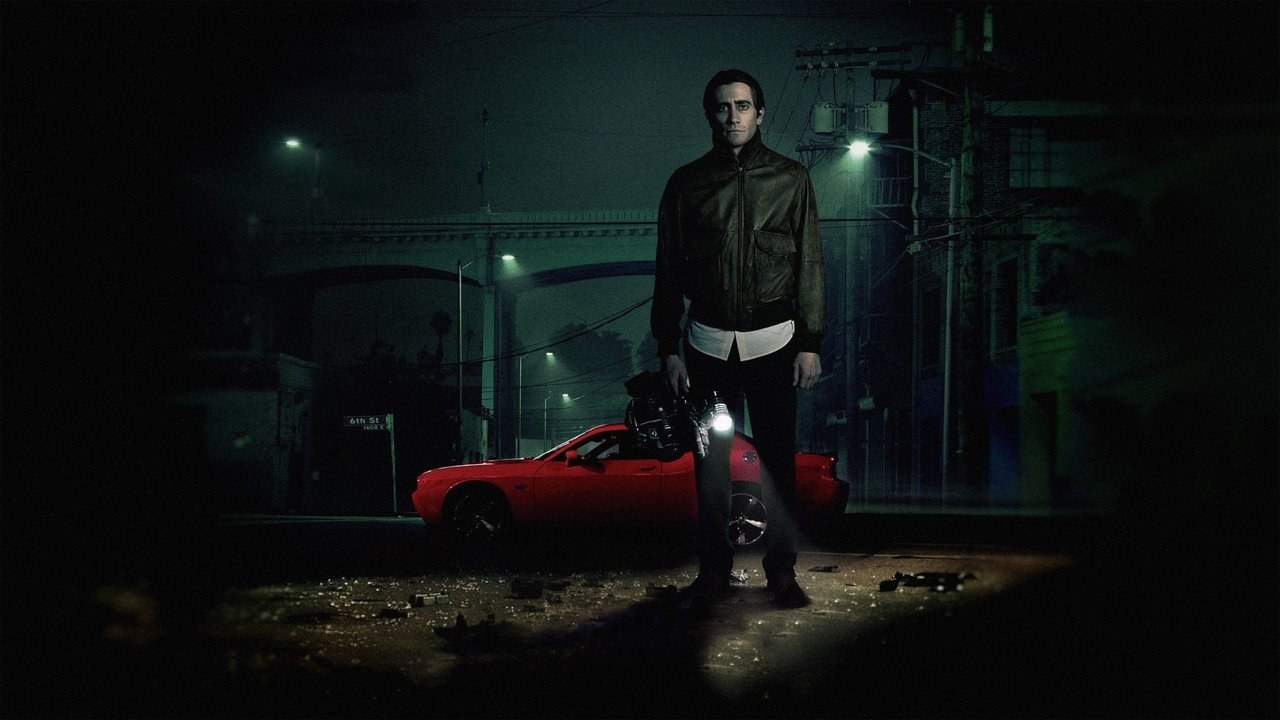
Louis Bloom, an unemployed drifter with a talent for persuasive, unsettling self-presentation and a hollow, endlessly repeated vocabulary of business-school platitudes, discovers a new career after witnessing freelance videographers filming a car accident to sell the footage to local news stations. Recognizing an opportunity, Louis buys a cheap camera and police scanner and begins pursuing accident and crime scenes himself, quickly proving to have an instinct for capturing the most graphic, marketable footage.
Louis’s ambition and willingness to cross ethical and legal lines – trespassing on crime scenes, tampering with evidence, and eventually staging and manipulating events to produce more dramatic footage – grow in direct proportion to his success, aided by a local news director, Nina, whose own job security depends on sensational ratings and who becomes complicit in encouraging his increasingly reckless methods. Louis hires a desperate, homeless young man, Rick, as an assistant, treating him with the same transactional, exploitative logic he applies to everything else in his rapidly expanding operation.
As Louis’s methods escalate toward outright criminality – withholding crucial information from police during an active manhunt in order to film its violent conclusion himself, and ultimately engineering Rick’s death to eliminate a witness and business liability – he faces no meaningful consequence, instead expanding his operation and hiring more desperate people to exploit in turn. The film ends not with Louis’s downfall, but with his continued, unchecked success, having fully mastered a system that rewards exactly the qualities that make him monstrous.
Analysis
Ambition Detached from Any Moral Anchor
Louis speaks constantly in the language of self-improvement, entrepreneurship, and personal achievement, yet this language is entirely detached from any actual moral content – his ambition recognizes no limit beyond what he can get away with, and no goal beyond his own advancement. The film’s unsettling achievement is to make this hollow, borrowed vocabulary of ambition sound, at first, almost plausible, before revealing just how thoroughly it has been emptied of any genuine ethical content.
This portrayal serves as a pointed critique of a certain kind of success-obsessed culture that measures achievement purely by results and advancement, without asking what has been sacrificed, or who has been harmed, to obtain them.
A System That Rewards What It Should Punish
Nina’s willingness to broadcast increasingly graphic, ethically compromised footage, driven by ratings pressure and her own precarious employment, makes her complicit in incentivizing exactly the behavior that should disqualify Louis from any legitimate business relationship. The film is careful to show that Louis’s monstrousness is not simply an individual aberration but is actively cultivated and rewarded by an entire system of local news economics built around sensationalism.
This systemic complicity means the film’s critique extends well beyond Louis himself to everyone who benefits from his methods while maintaining plausible deniability about how the footage was actually obtained – a chain of responsibility the film insists on tracing rather than isolating in one clearly villainous individual.
Exploitation Disguised as Opportunity
Louis’s treatment of Rick – offering him work when he is desperate and homeless, then exploiting his labor, withholding fair pay, and ultimately engineering his death once he becomes inconvenient – mirrors, in miniature, the same logic Louis applies to everyone and everything in his world: people and events alike are simply resources to be extracted from for his own advancement.
The film’s refusal to give Rick any meaningful protection or justice underscores its bleak assessment of how easily desperation can be exploited by those with power, especially when the exploitation can be dressed up in the language of opportunity, partnership, or mutual benefit.
Success Without Reckoning
Unlike many stories about morally corrupt ambition, the film pointedly denies its audience the satisfaction of Louis’s downfall or exposure; he ends the film more successful, more resourced, and more insulated from consequence than when it began, having learned only to be more careful, never to be different.
This refusal to punish Louis narratively is itself the film’s sharpest statement: that in a world structured the way this one is, moral corruption is not merely tolerated but actively rewarded, and that audiences hoping for a comforting resolution in which such behavior is ultimately punished should not expect the world, or this film, to guarantee it.
Questions for Discussion
1. Louis constantly uses the language of ambition and self-improvement, yet this language is emptied of any real ethical content. What does this contrast suggest about how ambition can be corrupted while still sounding respectable?
2. Nina becomes complicit in Louis’s increasingly unethical methods due to pressure to maintain ratings. How does the film distribute responsibility for Louis’s actions beyond Louis himself?
3. Louis treats Rick with the same exploitative logic he applies to everything else in his operation. What does this relationship reveal about how desperation can be used against vulnerable people, even under the guise of opportunity?
4. The film denies Louis any meaningful downfall or consequence for his actions. What effect does this ending have on you as a viewer, and why might the filmmakers have chosen it?
5. What responsibility do local news organizations bear, according to the film, for the kind of content Louis produces? Is Nina as culpable as Louis, more culpable, or less?
6. Louis withholds crucial information from police during an active manhunt in order to get better footage. What does this choice reveal about the priorities his entire worldview has been built around?
7. Is Louis simply a uniquely disturbed individual, or does the film suggest he is a logical, even inevitable, product of the system he operates within? Defend your answer.
8. What do you think the film is ultimately arguing about the relationship between success, as our culture often defines it, and moral character?


