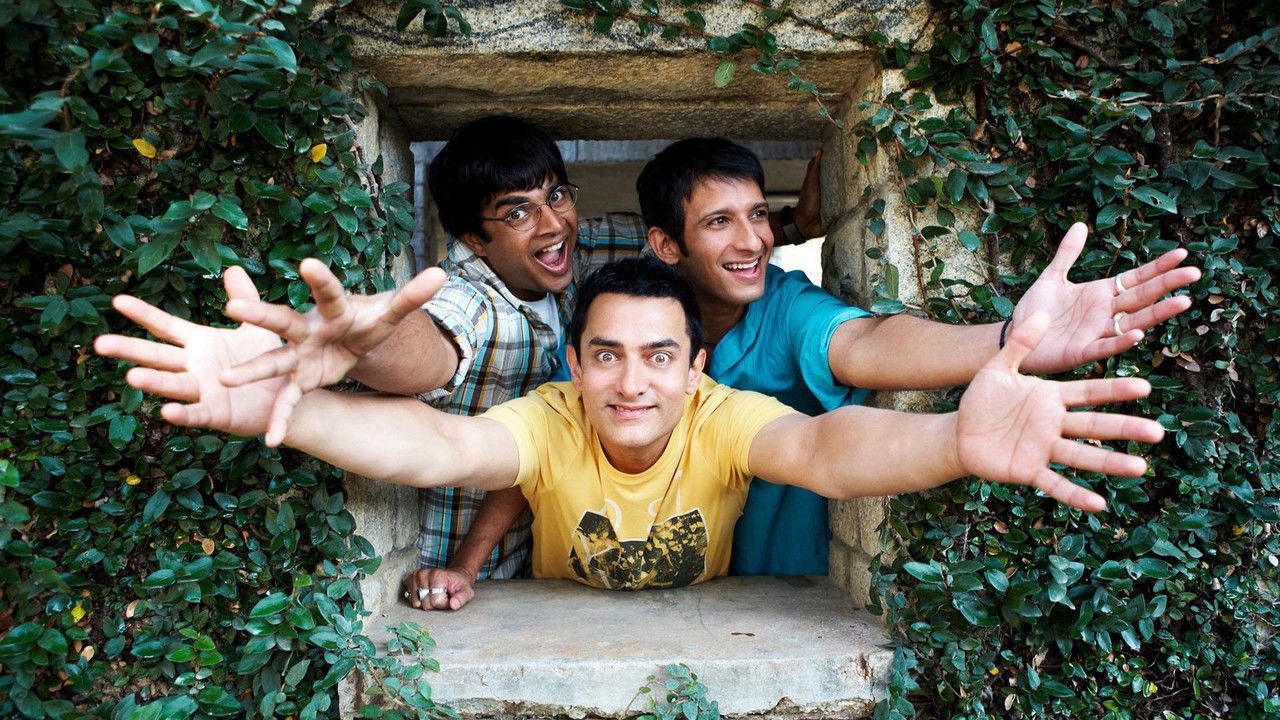
Synopsis
Farhan and Raju, two engineering students at a prestigious Indian college, reunite decades after graduation with their friend and former roommate Chatur to search for their long-lost third roommate, Rancho, whose disappearance immediately after their final exams has remained a mystery ever since, launching the film into an extended flashback recounting their tumultuous years together as students.
Rancho, unlike his classmates, pursues learning out of genuine curiosity and love of engineering itself rather than the crushing, fear-driven pressure to achieve top marks and lucrative careers that defines the rest of the student body, repeatedly clashing with the college’s rigid, rote-memorization-focused director, known to students as “Virus,” whose educational philosophy prizes rank and conformity over genuine understanding or innovation. Rancho’s encouragement helps Farhan find courage to pursue his real passion for wildlife photography against his father’s wishes, and helps Raju overcome the crushing anxiety and desperation instilled by his family’s poverty and expectations.
The flashback reveals that Rancho vanished after graduation because he was, in fact, a poor gardener’s son who had been secretly attending classes under a wealthy boy’s identity in exchange for tutoring that boy’s real coursework, a deception uncovered only after graduation. Farhan and Raju’s search finally reunites them with the real Rancho, now a successful, celebrated scientist and inventor living under his true identity, having built a life defined by the same authentic curiosity and integrity he modeled for his friends decades earlier, in stark contrast to Chatur’s outwardly successful but hollow, status-obsessed life.
Analysis
Learning Pursued for Its Own Sake
Rancho’s approach to engineering, motivated by genuine curiosity and delight in understanding how things work rather than fear of failure or desire for status, stands in sharp contrast to the anxious, grade-obsessed culture of his college, embodied most severely in his classmate Raju’s crushing fear of disappointing his family and the institution’s own rigid emphasis on rote memorization and rank.
This contrast offers a pointed critique of educational systems that prioritize measurable achievement and competitive ranking over genuine understanding and love of a subject, suggesting that the deepest, most durable competence tends to arise from curiosity and engagement rather than fear-driven compliance.
Friendship That Frees Rather Than Merely Comforts
Rancho’s friendship with Farhan and Raju is not merely emotionally supportive in a passive sense but actively liberating, giving each friend the courage to pursue paths – wildlife photography for Farhan, a life free of paralyzing anxiety for Raju – that they would not have found the confidence to choose on their own, against significant familial and social pressure.
This portrayal of friendship as a force that actively frees others toward their own authentic path, rather than simply offering comfort within an unchanged, constrained life, suggests a more demanding, transformative model of what genuine care for a friend’s flourishing can look like.
Identity Sustained Through Deception, Then Reclaimed Honestly
Rancho’s years at the college under a false identity, undertaken originally out of his own family’s poverty and a desire for an education otherwise unavailable to him, complicate a simple reading of his character as straightforwardly virtuous, since his entire presence at the institution rests on a significant, sustained deception of the institution and, initially, his own closest friends.
The film’s eventual resolution, in which Rancho is found living successfully and openly under his true identity, suggests that whatever compromises were required to access an opportunity otherwise closed to him, his authentic character – curiosity, integrity, generosity toward friends – proved durable enough to eventually be lived out honestly, on his own true terms, once circumstances allowed.
Success Measured by Fulfillment Rather Than Status Alone
Chatur’s storyline, in which he achieves conventional markers of success – wealth, status, an impressive title – yet remains defined by anxious status-seeking and a shallow understanding of his own field, offers a direct contrast to Rancho’s quieter but more genuinely fulfilling success, built on authentic engagement with work he loves rather than external validation.
This contrast between Chatur’s hollow achievement and Rancho’s genuine flourishing reframes the film’s central question about what constitutes a successful life, suggesting that external markers of achievement, however impressive, cannot substitute for the deeper satisfaction of a life and career built on authentic curiosity, integrity, and purpose.
Questions for Discussion
1. Rancho pursues engineering out of genuine curiosity rather than fear of failure or desire for status. What does the contrast between his approach and his classmates’ anxiety-driven pursuit of grades suggest about different motivations for learning?
2. Rancho’s friendship actively frees Farhan and Raju to pursue paths they would not have found the courage to choose alone. What distinguishes this kind of friendship from one that offers comfort without challenging a friend to grow?
3. Rancho attends college under a false identity due to his family’s poverty. Does this deception complicate your view of his character, or does his underlying integrity and generosity outweigh this compromise? Explain your reasoning.
4. Chatur achieves conventional success – wealth, status, title – yet remains shallow and anxious, while Rancho’s quieter success is built on genuine fulfillment. What does this contrast suggest about how the film ultimately defines a successful life?
5. The college’s director, “Virus,” prizes rank and rote memorization over genuine understanding. What does the film suggest about the potential harm of educational systems built primarily around fear and competition?
6. Raju’s crushing anxiety stems significantly from his family’s poverty and expectations. What role does Rancho’s friendship play in helping him overcome this paralyzing fear, and what does this suggest about the power of encouragement from others?
7. Is Rancho’s deception about his identity ultimately justified by the good it allowed him to access and later share with others? Where might you draw a line between understandable necessity and genuine wrongdoing?
8. What do you think the film ultimately suggests is the proper relationship between pursuing personal passion and meeting family or social expectations, given each of the three friends’ different paths?


