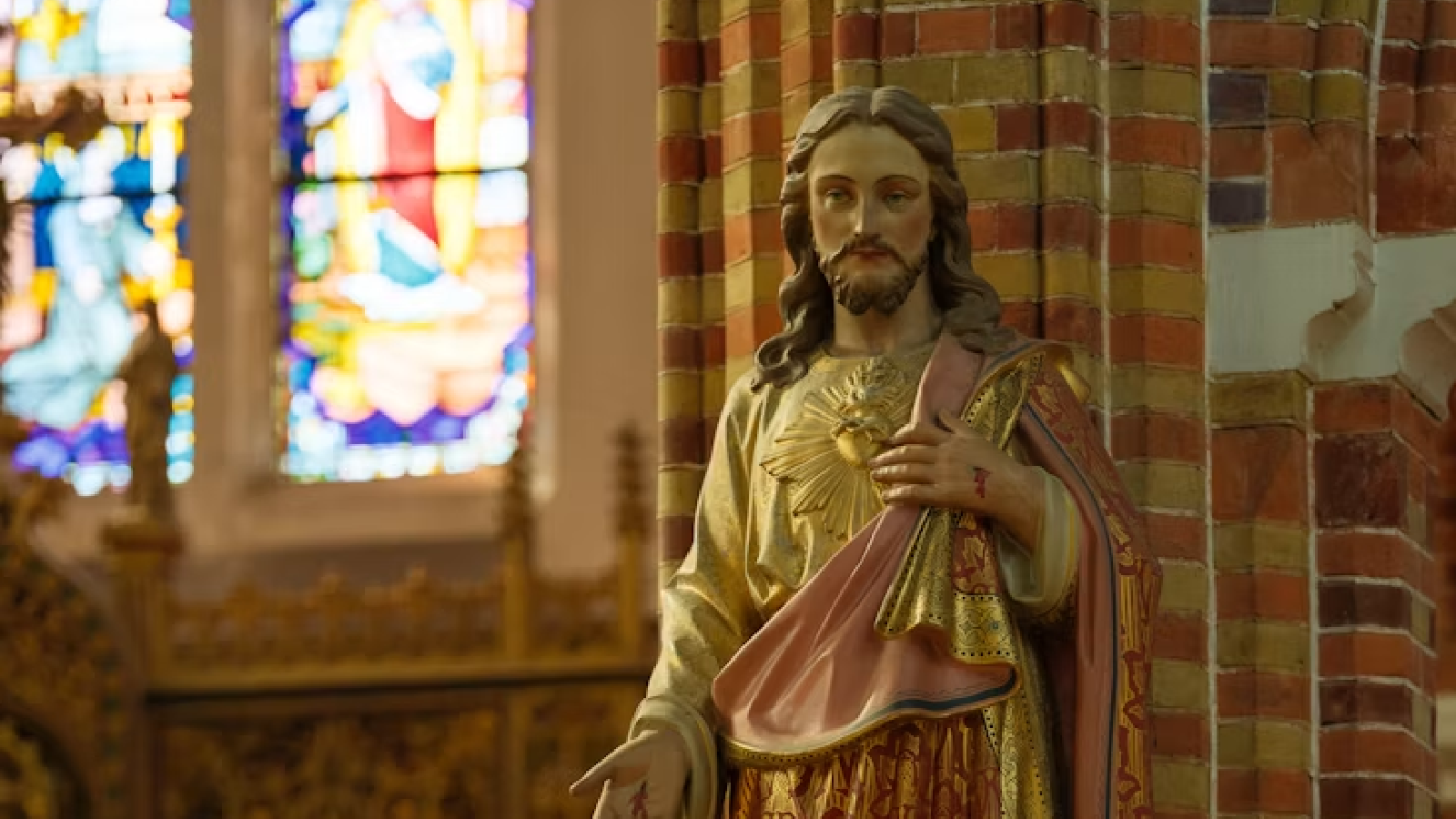
St. Paul exhorts the Christians of Philippi with the well-known words: “Rejoice in the Lord always; again I will say, rejoice” (Phil 4:4). He immediately gives the reason for such joy: “The Lord is at hand.” These words contain the secret of Christian joy. Christ is near us. He loves us and invites us to live in friendship with him. If we remain close to him, we possess a source of happiness that does not depend upon everything going well. When that friendship weakens through sin or spiritual negligence, something essential is missing, and we begin to look elsewhere for a happiness that created things cannot finally give us.
We see the connection between God’s presence and joy throughout the Gospel. The Angel Gabriel greets Our Lady with the words, “Hail, full of grace, the Lord is with you” (Lk 1:28). When Mary visits Elizabeth, the unborn John the Baptist leaps in his mother’s womb at the approach of the Saviour. At Bethlehem, the angel announces to the shepherds “good news of a great joy” because a Saviour has been born. In each case, the reason for rejoicing is ultimately the same: God has drawn near to his people. Humanity is no longer left to itself because God has entered our world to save us.
We see the same effect during the public life of Jesus. People wanted to be near him. Crowds followed him, children approached him freely, and those burdened by illness or sin sought him out because they sensed that he would receive them with compassion. Christ did not avoid difficult truths or simply tell people what they wanted to hear. He called them to conversion and sometimes spoke very demanding words. Yet those who approached him sincerely discovered that his demands opened the way to a fuller life. When he revealed a person’s sins, he did so in order to free that person and restore him to friendship with God.
The Samaritan woman came to Jacob’s well carrying the burden of a disordered life, but after her conversation with Jesus she returned to the town eager to tell others whom she had met. Zacchaeus received Christ into his home and emerged from the encounter ready to change his life and repair the injustices he had committed. Again and again, people who met Christ discovered that conversion did not diminish their happiness. It made genuine happiness possible.
The greatest example comes after the Passion. The disciples had seen Jesus arrested and crucified, and with his death their hopes seemed to have collapsed. Then the risen Christ appeared among them, and St. John tells us simply that “the disciples were glad when they saw the Lord.” Their joy was deeper than the happiness of seeing a beloved friend again. Christ had conquered sin and death. Everything he had promised was true, and the apparent catastrophe of Calvary had become the means of our salvation.
This gives us one of the deepest reasons for Christian optimism. The Passion appeared to be the triumph of evil. The innocent Son of God had been betrayed and condemned, while those who hated him seemed to have prevailed. Yet God brought from that terrible evil the greatest good in human history: the redemption of the world. St. Paul expresses the principle in the words, “For those who love God all things work together for good” (Rom 8:28). He does not say that everything that happens is good. Sin remains evil, injustice remains injustice, and suffering is genuinely painful. But none of these things lies beyond God’s power to redeem.
This conviction gives Christian joy a foundation that circumstances alone cannot provide. We naturally rejoice when life is going well. Good health, friendship, family happiness and meaningful work are genuine gifts, and we should receive them gratefully. Yet all these things are fragile. If our happiness depends entirely upon everything going according to our plans, we will always live with a certain insecurity. Health can fail, professional plans can collapse, people we love may disappoint us, and suffering sometimes arrives without warning.
Christ does not promise that those who follow him will escape suffering. On the contrary, he tells us clearly that we will have crosses. What he promises is that he will remain with us in the midst of them. Before his Passion, Jesus told the Apostles, “You have sorrow now, but I will see you again and your hearts will rejoice, and no one will take your joy from you” (Jn 16:22). He was speaking to men who would soon face persecution and, in most cases, martyrdom. The joy he promised therefore could not depend upon an easy life.
Christian joy should not be confused with being cheerful every moment or maintaining a permanently upbeat mood. There are times when we are naturally sad. We grieve when someone we love dies, suffer when relationships break down and become discouraged by failure. Our Lord himself wept at the tomb of Lazarus and experienced anguish in Gethsemane. We do not become more Christian by pretending that suffering does not hurt.
The joy Christ gives us lies at a deeper level. Even when we are grieving, we can know that we are loved by God and that he has not abandoned us. We can continue to trust him when we do not understand what he is doing. This is why the saints could remain joyful in circumstances that would seem to make happiness impossible. They were not immune to suffering, nor did they all possess naturally cheerful personalities. They had learned to place the deepest foundation of their lives in God.
When we lose our joy, our first instinct is often to look only at what is wrong with our circumstances. We imagine that we would be happier if a particular problem disappeared or if some person behaved differently. Sometimes our circumstances genuinely do need to change, and we should do what reasonably lies within our power to improve them. But it is also worth asking whether we have drifted away from the source of our joy. Prayer may have become superficial, we may have neglected the sacraments, or some attachment may have weakened our friendship with Christ. In such cases, changing our circumstances will not solve the deepest problem.
The parable of the prodigal son illustrates this beautifully. The younger son imagined that happiness lay somewhere far from his father’s house. He wanted freedom and independence, but once he had spent his inheritance he discovered how empty that freedom had become. His life began to change when he decided, “I will arise and go to my father.” The father had never stopped loving him.
Our own return to God may be much less dramatic. Perhaps we simply need to make a good Confession or begin praying with greater sincerity. We may need to recover the habit of speaking to Christ during the day and remembering that he is beside us. We do not have to manufacture Christian joy by forcing ourselves to feel cheerful. We recover it by returning to its source.
The same Lord who appeared to the Apostles after the Resurrection remains with us today. We meet him in prayer and especially in the Eucharist. We encounter him in the sacraments and learn to recognize his presence in the ordinary events of each day. The more deeply we live in his company, the less our happiness will depend upon whether everything happens as we would like.
There will still be difficult days. We will experience fatigue and disappointment, and at times we will carry crosses that seem very heavy. Yet beneath all these changing circumstances, one reality remains unchanged: Christ is with us. This is why St. Paul can tell us to rejoice always. “The Lord is at hand.”
Joy in the Midst of Difficulty
If our joy is rooted in Christ, difficulties do not have to destroy it. We will naturally feel sorrow when something painful happens, and there may be periods when we experience little emotional happiness. But beneath these changing feelings, we can retain the conviction that God is with us and that our lives remain in his hands.
This confidence comes above all from knowing that God is our Father. We are not simply creatures subject to forces beyond our control. We are his children, and nothing that happens to us takes him by surprise. It is relatively easy to believe this when life is going well. It becomes more difficult when illness, disappointment or some painful change enters our life.
There is nothing wrong with asking God why he has permitted something or asking him to remove a difficulty. Our Lord himself prayed in Gethsemane that the chalice might pass from him while remaining completely united to the Father’s will. We too should use all reasonable means to resolve problems and change what ought to be changed. Trust in Providence does not require passivity.
There comes a point, however, when we have done what we can and must place what remains in God’s hands. We may not understand why he has permitted something, but we can still believe that he has not ceased to love us. Bringing our concerns to prayer helps us do this. A problem that seems overwhelming when we turn it endlessly over in our own mind can begin to look different in the presence of God. Sometimes we see a practical step we had overlooked; at other times, the difficulty remains exactly the same, but we receive the strength to carry it.
We should not expect every problem to disappear. Difficulties form part of every human life, and no one escapes misunderstanding, temptation, illness or loss. If we tell ourselves that we will finally be happy when all our problems have been solved, we are postponing happiness to a day that will never arrive in this life. We need to learn to live with joy while problems still exist.
This does not mean becoming indifferent to them. We should solve what can be solved and accept responsibility for changing what needs to be changed. But we should not allow every unresolved difficulty to occupy the centre of our attention. One disappointment can easily overshadow many things that are going well. Gratitude helps us recover perspective because it prevents a single difficulty from making us forget the many gifts God continues to give.
Some crosses, of course, are too serious to be put into perspective simply by remembering our blessings. The death of someone we love or a grave illness may change our life permanently. In these circumstances, Christian joy takes a deeper form. We may not feel cheerful, and no one should expect us to pretend that we do. Our joy may consist simply in continuing to trust God through our tears because we believe that suffering and death do not have the final word.
The Resurrection changes the meaning of everything. If Christ had not risen, many of our sorrows would ultimately be without remedy. Death would permanently separate us from those we love. But because Christ has conquered death, even our greatest losses are placed within a larger hope. St. Paul therefore tells the Thessalonians not that Christians should never grieve, but that they should not grieve “as others do who have no hope” (1 Thess 4:13). We grieve because we love, but our grief is sustained by the conviction that death is not the end.
The same supernatural outlook helps us deal with our own failures. Sometimes the greatest obstacle to joy is not what another person has done to us but our disappointment with ourselves. We make mistakes and discover defects we thought we had overcome. Discouragement can then arise because we had formed an image of the person we thought we should be and are forced to confront our weakness once again.
God already knew that weakness. He knew everything about us when he called us, including the mistakes we would make and the defects against which we would have to struggle. Yet he still chose us and continues to offer us his grace. Our optimism therefore cannot rest principally upon confidence in ourselves. Experience gives us too much evidence of our fragility for that. Christian optimism rests on confidence in God.
When we fall, we acknowledge the fault honestly, ask forgiveness and repair any harm we have caused. Then we begin again. We do not need to dramatize every failure. Sometimes we should even learn to laugh at ourselves. We take ourselves far too seriously when every mistake becomes a personal catastrophe. A healthy sense of humour helps us remember that we are imperfect creatures and that the world will continue turning despite our blunders.
This does not mean making light of sin or refusing to take responsibility for serious mistakes. It means refusing to make ourselves the centre of the universe. We can admit that we behaved foolishly, learn what needs to be learned and move on. When we no longer need to maintain an idealized image of ourselves, our defects become easier to face. God loves the real person we are, not the imaginary person we sometimes wish we were.
Our weakness can even draw us closer to him. St. Paul begged God to remove what he called a “thorn in the flesh,” but the answer he received was, “My grace is sufficient for you, for my power is made perfect in weakness.” Some of the weaknesses we most dislike may force us to pray more and rely less upon ourselves. They can also make us more understanding of other people’s faults and less inclined to judge them harshly.
We should therefore resist the temptation to interpret every setback as a disaster. Sometimes what appears to be a failure redirects our life in a way we could not have foreseen. A disappointment may free us from an attachment or force us to reconsider priorities that had become disordered. We often recognize this only much later. Looking back, most of us can identify situations that seemed entirely negative at the time but eventually produced some unexpected good. The suffering was still real, but God’s providence was larger than our understanding of the event.
Our Lady gives us the supreme example of this trust. Her life was filled with circumstances she could not have anticipated. She gave birth to Christ in poverty, fled with Joseph and the Child into Egypt, and later watched opposition to her Son grow until she stood beneath the Cross. At Calvary, everything visible seemed to contradict the promises she had received, yet Mary remained faithful. Her sorrow was immense, but beneath that sorrow remained her complete trust in God.
Our own trials are usually much smaller, but the principle is the same. We do not need to understand everything before we can trust. There will be days when our prayer feels dry and our problems remain unresolved. We may not see any particular reason to feel cheerful. On such days, our joy can consist simply in knowing that we belong to God and continuing to do what he asks of us.
This kind of joy is deeper than good spirits. It is the peace of knowing that our life is in the hands of a Father who loves us. He has already shown at Calvary that he can bring the greatest good from what appears to be the greatest evil. We may not understand what he is doing now, but we know whom we have trusted.
Living and Spreading Christian Joy
If our joy comes ultimately from Christ, it should gradually become visible in the way we live. This does not mean that Christians must always appear cheerful or hide their difficulties behind a permanent smile. As our friendship with God deepens, however, we should acquire a fundamental optimism that affects the atmosphere we create around us.
Our disposition influences others more than we sometimes realize. We have all known people whose presence makes a room more pleasant because they take an interest in others, know how to laugh and do not make everyone around them carry the full weight of their problems. We have probably also experienced the opposite. Someone who habitually complains can create an atmosphere in which minor difficulties begin to seem more serious than they really are.
It is worth asking ourselves occasionally what kind of atmosphere we create, especially at home, where we are most likely to let down our guard. We may be pleasant and considerate with colleagues and then bring our frustrations home to the people we love most. There will certainly be times when we need to speak honestly about our problems, and friendship requires us to share burdens when appropriate. But there is a difference between sharing a difficulty and developing the habit of complaining about everything that displeases us.
Much of our daily happiness depends upon learning to accept ordinary imperfections. Plans change, people disappoint us and things do not always work as efficiently as we would like. Some situations genuinely need correction, and at times justice requires us to speak firmly. But many of the small annoyances of daily life are not worth allowing them to disturb us or the people around us.
A sense of humour helps enormously. We should be able to laugh when things go wrong, especially when the person who has gone wrong is ourselves. This is not frivolity. It helps keep our ego in proportion. We do not need to protect an image of ourselves as always competent, dignified or in control. There are situations in which laughter would be inappropriate, and people who are suffering need compassion rather than forced cheerfulness, but a healthy sense of humour can prevent us from becoming enclosed in ourselves.
Our joy also grows when we forget ourselves in the service of others. We sometimes become unhappy because we think too much about our own happiness, continually examining whether we are satisfied and whether others appreciate us. The more closely we monitor our emotional state, the more easily we notice everything that is missing.
One of the best ways out of this self-absorption is to turn our attention toward someone else. Our Lord tells us that “it is more blessed to give than to receive,” and we discover the truth of these words whenever we give our time to another person or make an effort to help someone who needs us. The sacrifice may cost us something, but afterward we often find ourselves happier than if we had spent the same time satisfying ourselves. We have been created to love, and fulfilment comes through giving ourselves rather than continually turning inward.
Christ shows us this even during his Passion. On the way to Calvary, he spoke to the women of Jerusalem. From the Cross, he entrusted his Mother to St. John and promised paradise to the repentant thief. At the moment when he had every human reason to be absorbed in his own suffering, his attention remained directed toward others.
We cannot imitate this perfectly. When we are tired or suffering, we naturally become more conscious of ourselves, and sometimes we genuinely need other people to care for us. Yet Christ’s example shows us the direction in which love should lead. Even in difficulty, we can ask whether there is still some small way to help another person rather than allowing our suffering to close us entirely in upon ourselves.
Christian joy also has an apostolic dimension. Many people today know Christianity mainly through rules or prohibitions and may imagine that faith consists chiefly in giving up things that make life enjoyable. A Christian who lives with genuine joy can challenge this impression more effectively than many arguments. People notice when someone possesses a deeper peace and can enjoy life without needing constant entertainment or becoming bitter when difficulties arise.
This does not mean manufacturing cheerfulness in order to attract people to the faith. Forced enthusiasm is unconvincing. Christian joy has to come from something real, and it comes from knowing Christ. When we live close to him, we gradually acquire a different way of looking at life. We know that we are loved and forgiven, that our existence has meaning, and that death does not have the final word. We know that even our failures can become occasions to return to God and begin again.
These convictions should affect the way we live. The Gospel is good news, and those of us who believe it should gradually become people marked by hope. This hope is especially important when we are with someone who is suffering. We should never offer easy explanations for another person’s pain or tell him simply to cheer up. Often the most Christian thing we can do is listen and remain beside the person. Even when we have no answer, however, we can still offer hope through our fidelity and friendship.
The saints often had this effect on people. Many lived through severe suffering, yet others were drawn to them because their difficulties had not made them bitter or self-centred. Their joy did not come from escaping the cross. It came from finding Christ there.
We see this especially in the martyrs. From a purely human point of view, martyrdom appears to be the destruction of everything a person values in this life. Yet accounts of the martyrs repeatedly describe remarkable peace and sometimes even joy as they approached death. This was not because they failed to value life. They could face death because they believed that Christ had already conquered it.
The same faith should shape the way we think about our own death. Much human anxiety comes ultimately from the fact that everything in this world can be lost. Health, possessions, achievements and earthly relationships are all temporary. If this life were everything, our happiness would always be shadowed by the knowledge that eventually we must lose it.
Christ has freed us from that hopelessness because our deepest happiness lies ahead of us. Heaven is not merely a consolation added to Christianity to make present suffering easier to bear. It is the fulfilment for which we were created. We have been made to see God and share his life forever. This does not make our earthly responsibilities less important; it gives them their true meaning.
We need to recover this supernatural perspective frequently because immediate concerns can easily fill our entire horizon. A professional setback or family difficulty begins to feel as though it defines our whole life. We forget that our earthly life, with all its joys and sorrows, is only the beginning. We are travelling toward our Father’s house.
This is why we can live with hope. We do not know what difficulties still await us, and we cannot guarantee ourselves good health or success. Our confidence does not come from pretending that we are invulnerable. It comes from Christ. He has entered into our suffering and death and transformed them from within. The Cross appeared to be the final defeat, yet it became the instrument of salvation. The sealed tomb appeared to mark the end of everything, but on Easter morning it was empty.
St. Paul tells us, “Rejoice in the Lord always.” The crucial words are “in the Lord.” He does not tell us to rejoice because everything is pleasant or because our plans have succeeded. We rejoice because Christ is with us. He knows us completely and still loves us. He forgives us when we return to him, strengthens us when we are weak and can bring good from circumstances we do not understand. He has also prepared for us a happiness beyond anything we can imagine.
We will still have days when we are tired or discouraged. There will be moments of grief and times when God seems distant. We do not need to pretend otherwise. Yet beneath everything that changes, Christ remains. We can return to him again and again in prayer and the Eucharist and learn to recognize his presence in the people and circumstances around us. As we live more deeply in his company, our joy becomes less dependent upon circumstances.
That joy naturally reaches others. We become more able to forget ourselves, recover more readily from disappointments and laugh at our own mistakes. When someone is suffering, we can offer something more than superficial optimism because our hope is grounded in Christ. Our Lord told the Apostles before his Passion, “These things I have spoken to you, that my joy may be in you, and that your joy may be full” (Jn 15:11). This is the joy he wants for us: not a life without suffering, but a life lived with him, sustained by confidence in his grace and by the knowledge that our Father’s house awaits us.
*By the Via Virtutis team
Photo by Haberdoedas on Unsplash


