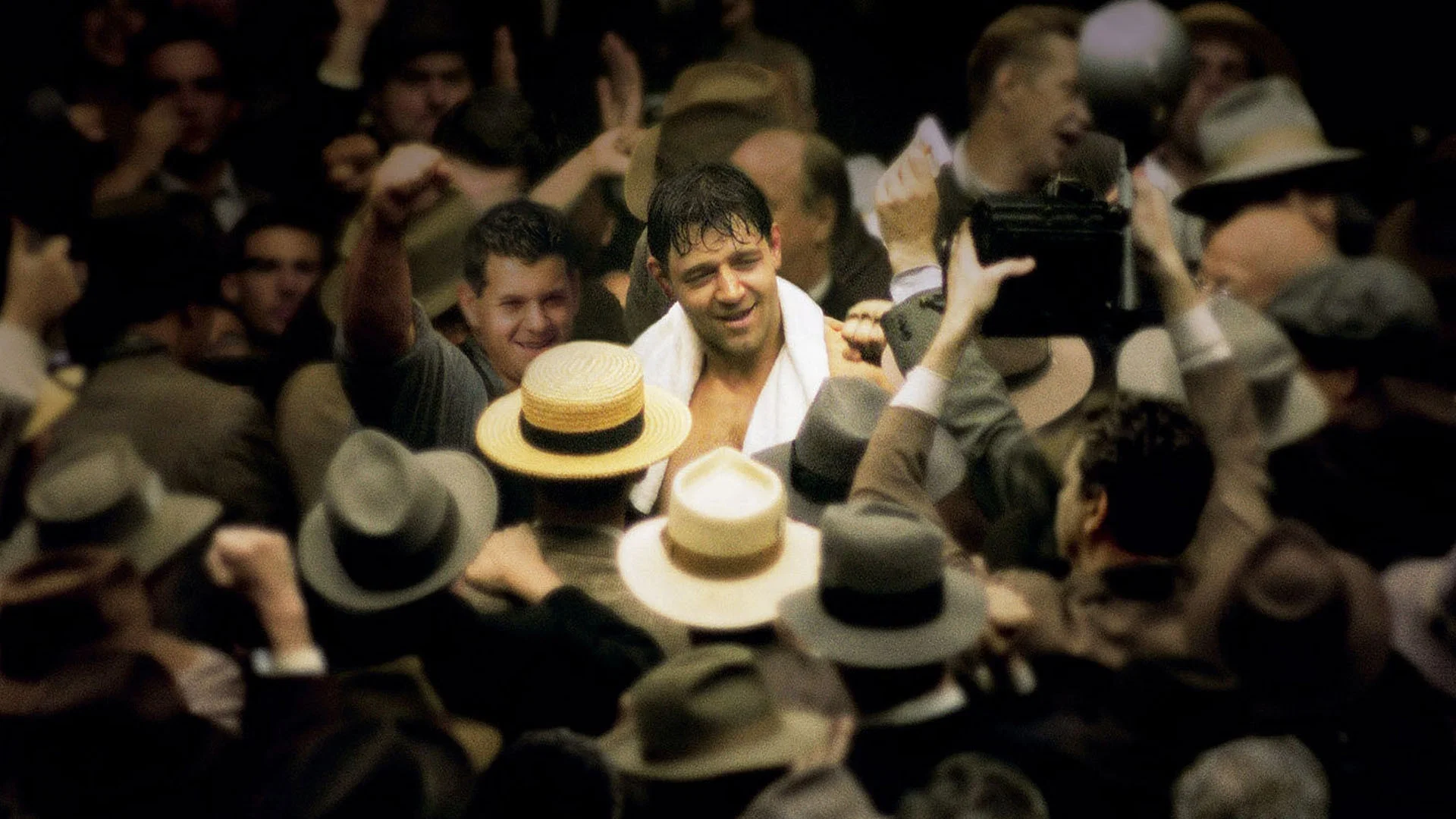
Cinderella Man is an exquisitely acted ‘human interest’ movie, based on a true story. The story begins in 1928. James J. Braddock, an Irish-American from New Jersey, is the toast of the boxing world – he is on the rise to stardom and is expected to contend for the light heavyweight championship. We are introduced to his manager Joe Gould, and to his wife Mae and his kids. Braddock owns a nice house, loves his family, and has everything ahead of him – life is good.
The story now moves to 1933. The Great Depression has hit America; people are out of work all over the States and times are hard. Braddock is still boxing to earn money for his family, but he is a washed-up version of himself – though he has still never been knocked out, his days as a prime fighter are over. His right hand is injured, and finally breaks in a fight with Abe Feldman. After this, his license to fight is revoked – he is finished as a fighter.
Now he is forced to go down to the docks with dozens of other men, all hoping to be selected for work. However, Braddock is usually unable to get work. His family are still together, close and loving, but the bills are adding up. Eventually, in the middle of the winter, their heat is turned off because they can’t afford to pay their bill. Mae decides that they have to send the children away – they can no longer even keep them warm. Braddock, however, doesn’t want the family to be separated. He applies for social assistance from the government, and then begs for money from his former boxing associates. This raises enough money to pay the heating bill and the kids are able to return home.
Braddock finally gets work down at the docks, where he meets and becomes friends with Mike Wilson. Because his hand is still healing, Braddock is forced to rely more on his left hand, which had always been his weak hand in boxing.
Then, a break comes for Braddock – Joe Gould manages to get him a fight with the number two contender, Corn Griffin. The fight only became available because of a last-minute cancellation, and the idea is that it will be one last fight for Braddock, and a chance for people to see Griffin knock out a man who had never been knocked out before. Braddock eagerly takes the fight because of the $250 dollars it will get him.
In the ring, Braddock wins an astonishing upset by defeating Griffin. Gould then tells Braddock that he might be able to get him more fights. Even though Mae doesn’t like the idea, Braddock eventually convinces her to let him start training again. To everyone’s surprise, Braddock keeps winning boxing matches, and is named the “Cinderella Man” by sportswriter Damon Runyon. Eventually, Braddock is in line to fight Max Baer for the championship. Baer is a brutal boxer who has killed two men in the ring.[1] Despite efforts by both the fight promoter and Baer himself to intimidate him into not fighting, and despite Mae’s fears, Braddock is determined to fight. The hopes of struggling Americans, especially the Irish, are placed on him – he is seen as a hero for his rise from poverty to stardom. Eventually, seeing this support, Mae also supports him – “You can’t win if I’m not behind you” she reminds him.
On June 13, 1935, Braddock defeats Baer in 15 rounds in a major upset, capping his remarkable return to the boxing world. This is where the movie ends, though the titles at the end of the movie note that the real-life Braddock would go on to fight in the Second World War and then work on the same docks where he had worked during the Depression; he and Mae also bought a house and lived in New Jersey for the rest of their lives.
Analysis
The over-riding emphasis of Cinderella Man is on the importance of family. Braddock is a family man from beginning to end – right near the beginning of the film, Gould asks him jokingly: “You still married to the same woman?” Braddock is shown in the midst of his family during his glory years – he and his wife are deeply in love, he has three children whom he openly loves. Fame and money are not a corrupting influence for him.
A few years later, when they have entered poverty in the Great Depression, nothing has changed – Braddock and his wife are shown as much in love as ever, Braddock is still loving and affectionate towards his children; they remain a close-knit family that leans upon each other for support. Neither wealth nor poverty has managed to break them apart.
This closeness, and how important that closeness is for Braddock, is shown in the episode when his son is caught stealing a sausage. Braddock makes him return it, telling him “Just because things ain’t easy, that doesn’t give you an excuse to take what’s not yours.” His son explains what led him to take the sausage – it was from fear that he would be sent away because his parents could no longer take care of him. The son’s greatest fear is the break-up of the family. Braddock promises him that they will never send him away.
This promise, however, proves difficult to keep. With the heat turned off, and one of their children falling sick, Mae feels that she has no choice but to send the children away for a while. This is the worst possible outcome for Braddock – he is unable to keep his promise to his own son, and unable to keep his family from being separated. Hence he does what he never would have done otherwise – he swallows his pride and applies for social assistance. Then he goes even further – he is willing to go and beg for money from the men with whom a few short years earlier he had been on equal terms. Braddock is willing to do even this for the sake of keeping his family together. A very moving moment then occurs when the children return home – they are thrilled and excited to be back in their impoverished little apartment. This is ‘home’ – all together, with their parents, among their familiar surroundings, even though it is a miserable little place where they hardly eat enough and drink watered down milk.
Braddock is also willing to put his pride aside for the sake of his family when Gould offers him the chance to fight for $250. Gould warns him – this fight is all about people being able to see the former contender being destroyed in the ring by Corn Griffin. But for Braddock, that doesn’t matter because he will be getting the money to pay his family’s bills. “For 250 dollars,” he tells Gould, “I’d fight your wife!” Once he begins rising to the top again in the boxing ring, Braddock is clear what he is fighting for – “Milk!” It is all done for his family.
The importance of his family also comes through in his relationship with his wife Mae. His boxing career has always been very difficult for Mae to accept – at one point she tells him, “Every time you get hit, feels like I’m getting’ hit too.” She is even secretly glad when he breaks his hand, because now he won’t be able to fight anymore. It terrifies her when he is in the ring, that something worse than a broken hand will happen to him.
And yet, it is her support that allows him to succeed. When he is trying to convince her to let him start fighting again in order to support their family, he tells her “I know this isn’t what you want, but I can’t win if you’re not behind me.” She replies: “I’m always behind you.” Later on, before his fight with Max Baer, she gives him her support, reminding him that “You can’t win without me behind you.” “That’s what I’ve been trying to tell you,” he replies.
Fighting for one’s family
Another reality that comes through very clearly in the movie is the importance for a father to be able to provide for his family, not just for his family’s sake, but for his own. We see in the movie fathers and husbands being deprived of their ability to support their families – with the onset of the Great Depression, thousands of men lost their jobs. With this comes a deep sense of helplessness and desperation, that everything has been taken out of their control by events which they could neither foresee nor mend.
Braddock’s friend Mike Wilson is one example of this. He shares Braddock’s frustration with this lack of control over their lives. For Wilson, the solution has to lie in banding together to fight. But, as Braddock points out, fight what? This is the difficulty of their situation – there is no clear enemy they can fight, no clear opponent they can vanquish in order to achieve their goals.
This lack of control is extremely difficult for Braddock. At one point, he explains his need: “I have to believe that when things are bad I can change them.” As a human being, but most especially as a father and husband, this is his ongoing struggle. His very sense of purpose and self-worth comes from his ability to provide for his family – hence his refusal to allow the family to become separated. If the family is broken apart by poverty, then he has failed. This is how reality presents itself to him.
Mrs. Gould understands this point very well and expresses it to Mae when Mae goes over to the Goulds’ place. Like Braddock, Gould is down on his luck, trying to make ends meet. Mrs. Gould says the following: “See, I never know who its harder on, them or us. We have to wait for them to fix everything. And every day, they feel like they’re failing us. And really, it’s just the world that’s failed, you know?”
This quote sums up the central conflict of the movie. For Braddock, Gould, and Wilson, the husbands and fathers in the movie, the Great Depression has ripped control from their hands and cast them into poverty. They can hardly support their wives and families, and so they are eaten away inside by the conviction that they have failed them. For Mae, Mrs. Gould, and Sara Wilson, the wives and mothers in the movie, they have to watch the pain of their husbands, supporting them as best they can, and, as Mrs. Gould said, essentially “wait for them to fix everything.” As Mae knows very well from having to endure Braddock’s boxing, having to watch someone you love suffer is perhaps even more difficult than the suffering itself.
For Braddock, then, the opportunity to box comes as a “second chance” – an opportunity to once again provide for his family and allow him to regain some control over his own life. At first Mae is terrified by this, and even insists that he find a way not to fight Max Baer. However, eventually she changes her mind and throws her support behind him. This is not because she is no longer afraid – far from it! However, going to the church to pray for Braddock, she sees hundreds of other people there praying for him as well. She realizes that Braddock has become a symbol of hope for all the people mired in poverty, who have lost control over their lives and need hope that it is possible to rise out of the mire. As she tells Braddock: “Maybe I understand, some, about having to fight. So you just remember who you are… you’re the Bulldog of Bergen, and the Pride of New Jersey, you’re everybody’s hope, and the kids’ hero, and you are the champion of my heart, James J. Braddock.”
This quote should go with Mrs. Gould’s as one of the key moments in the film. Mae’s words in a sense sum up the whole point of the story of Jim Braddock. First, she says that she “understands” about “having to fight.” She understands his need to fight for his family, but also his need to be in a fight over which he has some control, not simply flailing away pointlessly at a cruel fate. She understands how boxing gives him this opportunity. Second, she reminds him who he is, and she lists five. The “Bulldog of Bergen” was his boxing nickname when he was on top; she also reminds him of his roots in New Jersey; then she tells him that he is “everybody’s hope.” She is reminding him of what she saw in the church, that this fight is about more than just Jim Braddock and his family. But then she closes with the two most important things – he is his children’s hero and the champion of her heart. This is the core of who he is and why he needs to fight; it is also what he needs in order to succeed. Once again, we are back to family.
Questions
1. “See, I never know who it’s harder on, them or us. We have to wait for them to fix everything. And every day, they feel like they’re failing us. And really, it’s just the world that’s failed, you know?” (Mrs. Gould)
- What can this quote tell us about James Braddock’s struggle and his motivations? How does it help shed light on Mae’s struggle?
2. What does this movie tell us about what it means to be a good husband and father?
3. At one point, at the height of their sufferings, Braddock says: “I’m all prayed out.” Why do you think he says this? How would you respond to him?
4. Why does Braddock become such a symbol of hope for people? What is it about his story that makes him so inspiring?
[1] Note that, according to the Wikipedia page for ‘Cinderella Man’, the movie’s depiction of Baer is not based on evidence – while he did kill one man in the ring (the second was never proven), he was apparently devastated by it. Further, he was actually a good guy.